Greyhound Racecard Abbreviations and Symbols
Best Greyhound Betting Sites – Bet on Greyhounds in 2026
Loading...
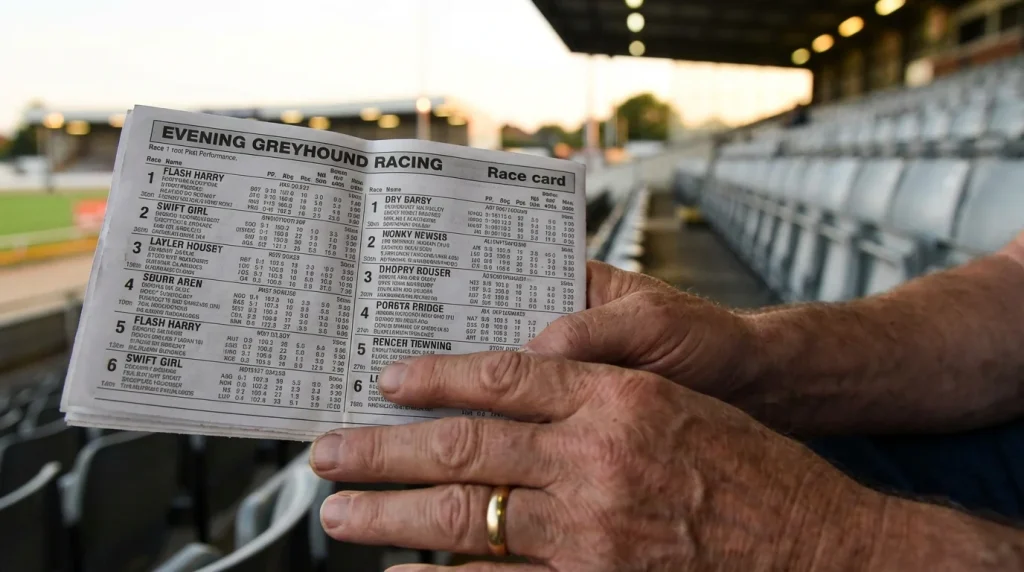
A greyhound racecard, at first glance, looks like someone spilled alphabet soup across a spreadsheet. SAw. Crd. Bmp. VW. EP. Bdblk. These compressed fragments of text carry more information per character than almost anything else in sports betting, and learning to decode them is the difference between reading form and staring at it blankly. Each abbreviation describes a specific event during a race — a slow start, a collision on the bend, a wide run, a strong pace — and together they reconstruct the story of a dog’s performance in a way that finishing position alone never can.
UK greyhound racecards follow a broadly standardised format, though minor variations exist between tracks and between print and digital versions. The abbreviations themselves are consistent across the sport, governed by convention and the requirements of the Greyhound Board of Great Britain. Once you know the core set, you can read a racecard from Romford, Hove, Monmore or any other licensed venue without needing a separate translation guide.
Running Abbreviations
The running abbreviations describe how a dog moved during the race — its pace, its position, and its general approach to the contest. These are the most frequently seen codes on any racecard and form the foundation of understanding a dog’s style.
EP — Early Pace. The dog showed significant speed in the opening phase of the race, typically from the traps to the first bend. An EP remark indicates that the greyhound was among the quickest out of the starting boxes and was prominent in the early running. For bettors, a consistent EP tag is a strong indicator of a front-runner: a dog likely to lead or be close to the lead at the first turn. At tracks with short runs to the first bend, like Crayford’s 77 metres, early pace was often the decisive factor.
SAw — Slow Away. The dog was slow to leave the traps. This is one of the most common and most important abbreviations on the card. A SAw in a dog’s most recent run might explain a poor finishing position that doesn’t reflect its true ability. If a dog is typically quick from the boxes but showed SAw in its last outing, the next start could see it revert to form — offering value if the market has overreacted to the one bad break.
MsdBrk — Missed Break. Similar to SAw but more severe. The dog had a significant delay leaving the traps, losing multiple lengths before the race had properly begun. A MsdBrk almost always results in a poor finishing position and can distort form analysis if taken at face value.
QAw — Quick Away. The opposite of SAw. The dog broke fast and cleanly from the traps. A string of QAw entries in the remarks column signals a reliable starter — a dog that can be expected to be competitive from the opening stride.
VW — Very Wide. The dog ran a wide racing line, covering significantly more ground than the rail runners. VW is common for trap 6 dogs or greyhounds with a naturally wide running style, but it can also appear when a dog is forced wide by traffic. The distinction matters: a habitual wide runner will show VW regularly and its form reflects the extra distance; a dog forced wide by a one-off incident may have been unlucky rather than slow.
RnUp — Ran Up. The dog ran close to the inside rail throughout. This is the economical route and generally favourable. A consistent RnUp suggests a genuine railer — a dog that saves ground on every bend.
Fin — Finished well. The dog closed strongly in the final stages of the race, making up ground on the leaders. A Fin remark combined with a middle-of-the-pack finishing position suggests the dog might be better over a slightly longer distance or might benefit from a more favourable trap draw that gives it a clearer run in the early stages.
Trouble Abbreviations
The trouble abbreviations record incidents during the race — interference, crowding, checking, and other events that affected a dog’s run. These are essential for accurate form assessment because they separate genuine performance from compromised performance.
Crd — Crowded. The dog experienced crowding from other runners, typically on a bend where multiple dogs converge. Crowding costs a dog its momentum and its racing line, often resulting in lost lengths that are impossible to recover. A Crd remark is a legitimate excuse for a poor run and should be factored into any assessment of the dog’s next race.
Bmp — Bumped. A direct physical contact between two dogs. More severe than general crowding, a bump can knock a greyhound off stride entirely. Bmp entries are common at tracks with tight bends where the field compresses into a small space.
Bdblk — Badly Baulked. This is the most severe interference code. The dog was significantly impeded by another runner, losing substantial ground and any chance of a competitive finish. A Bdblk in a dog’s most recent run should be treated almost as a non-runner for form purposes — the result tells you nothing about the dog’s actual ability on the night.
CkBnd or Ck — Checked at bend. The dog had to check its stride going into or through a bend, usually to avoid a collision with another runner. Checking breaks a greyhound’s rhythm and costs time, but it is less severe than a full baulk.
StbBnd — Stumbled at bend. The dog lost its footing on the turn, which can indicate either the track surface causing an issue or the dog losing balance due to the tightness of the turn. Repeated stumbling should raise fitness or injury concerns.
FcdTCk — Forced to check. An external cause made the dog break stride. This often accompanies a distance measurement (e.g., FcdTCk 3/4) indicating how much ground the dog lost. This abbreviation is a clear sign that the result was compromised by circumstances rather than ability.
Race Outcome Abbreviations
Beyond the running remarks, racecards include abbreviations that describe the outcome and the broader context of each race.
Won — straightforward: the dog won the race. Usually accompanied by the winning distance (e.g., Won 2L means the dog won by two lengths).
Btn — Beaten. Followed by a distance figure, this tells you how far behind the winner the dog finished. Btn 3L means beaten three lengths. This figure, combined with the winning time and going correction, allows you to estimate what the dog’s own time would have been — useful for comparing form across different races.
DH — Dead Heat. Two dogs crossed the line simultaneously. Dead heats are rare in greyhound racing but they do occur, and they affect betting settlements (stakes and returns are halved).
dnf — Did Not Finish. The dog failed to complete the race, usually due to injury. A dnf is a red flag for subsequent entries — it may indicate a physical problem that hasn’t been resolved.
R — Reserve. The dog was called in as a reserve to replace a withdrawn runner. Reserve dogs may not have been specifically prepared for this race and might be racing at a distance or from a trap that doesn’t suit them.
Season and Status Codes
Female greyhounds — bitches, in the sport’s terminology — carry additional codes related to their season (reproductive cycle), which can affect performance.
Ssn or in season — indicates the bitch is currently in season or has recently been in season. A bitch coming into season may show altered form: some lose focus and run below their usual standard, while others are largely unaffected. Trainers are required to declare a bitch’s season status, and the racecard will note how many weeks post-season the dog is. A bitch running at eight weeks out of season is typically close to full fitness; one at three or four weeks may still be below par.
Br or Ir — Country of birth. Br indicates the greyhound was bred in Britain; Ir indicates Ireland. Irish-bred dogs make up a significant proportion of the UK racing population, and many top-class greyhounds are imported from Ireland at a young age.
The whelping date, shown as a month and year (e.g., Jn ’21 for June 2021), tells you the dog’s age. Age is a relevant form factor: a two-year-old is typically still improving, a three-year-old is at or near peak, and a four-year-old or older may be beginning to decline. Knowing the exact age allows you to contextualise recent form — a rising young dog warrants optimism; a veteran posting declining times does not.
Alphabet Soup with a Pattern
The abbreviations look intimidating only until you recognise that they fall into just a few categories: how the dog broke, how it ran, what trouble it encountered, and how it finished. A racecard entry that reads SAw-Crd-Fin tells a clear story in three fragments — the dog was slow to start, got crowded on a bend, and finished well despite the setbacks. That is a dog with ability that had a bad trip. The next time it draws a favourable trap and breaks cleanly, the form line will look entirely different. The abbreviations are not decoration. They are the race, compressed into text. Read them properly and you are watching the replay without needing the video.