Greyhound Race Weight and Age: Do They Matter?
Best Greyhound Betting Sites – Bet on Greyhounds in 2026
Loading...
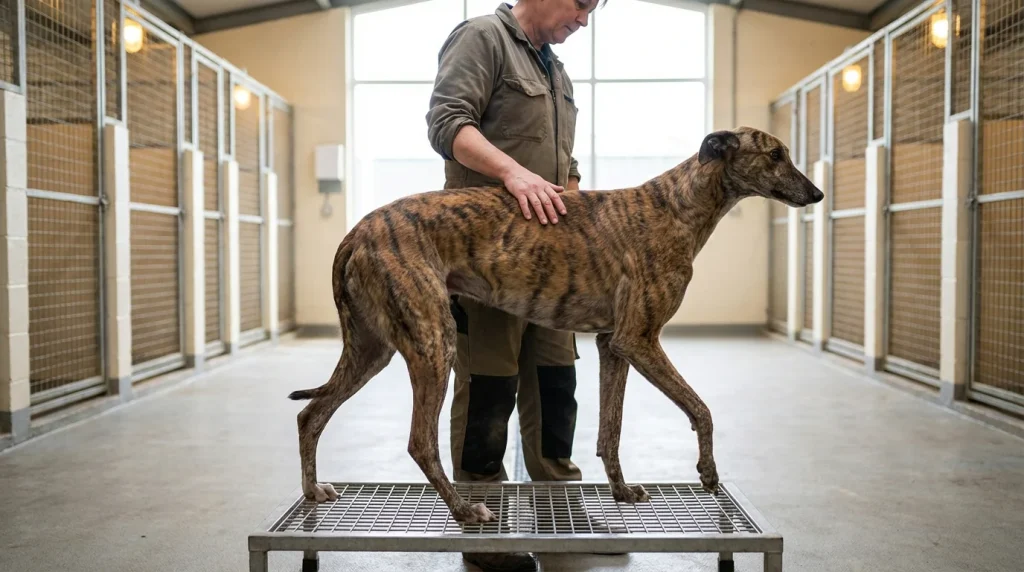
Every greyhound is weighed before it races, and every racecard lists the dog’s weight in kilograms alongside its age, colour, sex and breeding. Most punters glance at the weight column and move on. It looks like administrative data — something the authorities track for regulatory purposes rather than a number that should influence a betting decision. That assumption is partly correct. Weight alone is not a strong predictor of race outcomes. But weight change — the difference between a dog’s current weight and its weight at its last few starts — carries a signal that is worth reading.
Age is the longer arc. A greyhound’s racing career typically spans two to four years, beginning around eighteen months and declining by the time the dog reaches four or five. Within that window, performance follows a curve: improvement through the early career, a peak period of twelve to eighteen months, then a gradual decline as speed and recovery diminish with age. The racecard shows the dog’s whelping date, giving you the information needed to place any individual run within the context of this career trajectory.
Weight: How Much Variation Is Normal
A racing greyhound typically weighs between 26 and 36 kilograms, depending on sex, breeding and individual build. Males tend to be heavier — 30 to 36 kilograms is a common range — while females generally sit between 25 and 32. Within these bands, each dog has a natural racing weight: the weight at which it performs best, established over its racing career and maintained by its trainer through controlled feeding and exercise.
Race-to-race weight fluctuations of 0.2 to 0.5 kilograms are normal and usually insignificant. A dog might weigh half a kilo more one week because it ate slightly more before being transported, or half a kilo less because it was exercised more vigorously that day. These minor variations fall within the margin of normal biological fluctuation and should not influence betting decisions.
Fluctuations of 0.5 to 1.0 kilogram between consecutive runs are more noteworthy. A kilogram represents roughly 3% of a typical greyhound’s body weight — proportionally similar to a 75-kilogram human gaining or losing two to three kilograms in a week. Changes of this magnitude can reflect genuine shifts in condition: muscle gain from increased training intensity, weight loss from illness, or changes in hydration and feeding routine.
Anything beyond a kilogram of change between races should be treated as a flag. It may indicate injury recovery (dogs often lose weight during rehabilitation), a change in training method, or the onset of a health issue that has not yet been publicly disclosed. The racecard will not tell you why the weight changed — only that it did. Interpreting the reason requires context: the dog’s recent form, any gaps between races, and whether the direction of change (up or down) aligns with improving or declining performance.
Weight Change as a Form Indicator
The useful signal is not the absolute weight but the trend. A dog that has gained 0.8 kilograms over its last three races while also improving its calculated times is probably gaining muscle and fitness — a positive combination that suggests further improvement may follow. A dog that has lost a kilogram over the same period while its times have deteriorated may be struggling with a fitness issue that the racecard’s remarks column doesn’t capture.
Weight loss after a break from racing is common and often benign. A dog returning from a layoff — whether for injury, seasonal rest, or a bitch’s time out of season — will frequently come back slightly lighter than its pre-break racing weight. The first one or two runs back are typically used to regain race fitness and sharp match practice, and the weight usually returns to its normal level within a few starts. Backing a dog on its first run after a break purely because its recent form was strong is a common punting error; checking the weight for signs of underpreparation adds a useful filter.
Weight gain without corresponding performance improvement is a less positive sign. A dog that is getting heavier while its times slow may be losing its racing edge — carrying condition rather than muscle, or simply not being trained with the same intensity. Trainers manage their dogs’ weight carefully, and persistent weight gain in an active racer can indicate that the dog is past its competitive peak or that the training regime is not optimal.
The practical application is simple: note each dog’s weight on the racecard, compare it to the weights listed for its last three to five runs, and flag any change greater than half a kilogram. If the change aligns with the direction of the form — weight up, times improving — it confirms the trend. If it contradicts the form — weight down, times also down — it raises a question that the rest of the form analysis may not answer.
Age and Career Arc in Greyhound Racing
Greyhounds begin their racing careers between fifteen and twenty-four months of age, after a period of schooling where they learn to chase the hare, break from the traps, and navigate bends at speed. Early career runs are often inconsistent: young dogs are still developing physically, learning race craft, and being sorted by the grading system into appropriate levels. A two-year-old posting erratic form — a strong run followed by a poor one — is not necessarily a bad dog; it is a young dog still finding its feet.
The peak performance window for most greyhounds falls between roughly two-and-a-half and three-and-a-half years of age. During this period, the dog has reached physical maturity, has accumulated enough race experience to handle traffic and tactical situations, and has not yet begun the gradual decline in speed and recovery that comes with age. Dogs in this window tend to produce their most consistent form, their fastest calculated times, and their best results in competitive open races.
After three-and-a-half to four years, most greyhounds begin to slow. The decline is not a cliff — it is a gradual erosion, measured in tenths of a second per race that accumulate over months. A dog that was graded A3 at three years old might drift to A5 or A6 by the time it reaches four, not because it has forgotten how to race but because its muscles have lost a fraction of their explosive power and its recovery between races takes longer. Trainers manage this decline by adjusting the dog’s race frequency, selecting distances that suit its changing profile, and eventually retiring it when the competitive level drops below what is viable.
For bettors, the age-performance relationship creates clear analytical guidelines. A young dog rising through the grades is a positive trend to follow — it is likely still improving and may have more to give. A dog at peak age holding its grade consistently is a reliable performer and a sensible selection in competitive graded races. An older dog dropping through the grades is a declining asset, and while it may still win races at lower levels, it is unlikely to return to its former heights.
Combining Weight and Age in Form Analysis
Weight and age interact. Young dogs often gain weight as they mature, adding muscle through their second and third years. This weight gain is healthy and correlates with improving performance. An older dog gaining weight without improving its times is a different story — it may be losing muscle definition and gaining less useful mass.
A young dog that is both gaining weight appropriately and climbing through the grades is about as positive a form profile as greyhound racing offers. It is literally growing into a better racer. Conversely, a four-year-old that is losing weight and dropping grades is a dog in the final phase of its career, and however good its historical form, the current trajectory is downward.
The racecard provides both numbers — the weight for the current race and the whelping date that determines the age. Combining them takes seconds and adds a layer of context that pure time-and-position analysis misses. It is not a system. It is a filter: one more piece of information that tilts the probability assessment in one direction or another, by a small amount, often enough to matter.
Kilograms Don’t Win Races — but They Signal
Weight and age will not tell you the winner of a greyhound race. No single factor will. But they provide context that other form variables cannot: the physical condition of the dog and its place on the career timeline. A half-kilogram change is a whisper, not a shout. An age-related decline is a slow tide, not a sudden drop. Neither demands a dramatic revision of your assessment. Both deserve a glance before you commit your money.