How Greyhound Racing Grades Work in the UK
Best Greyhound Betting Sites – Bet on Greyhounds in 2026
Loading...
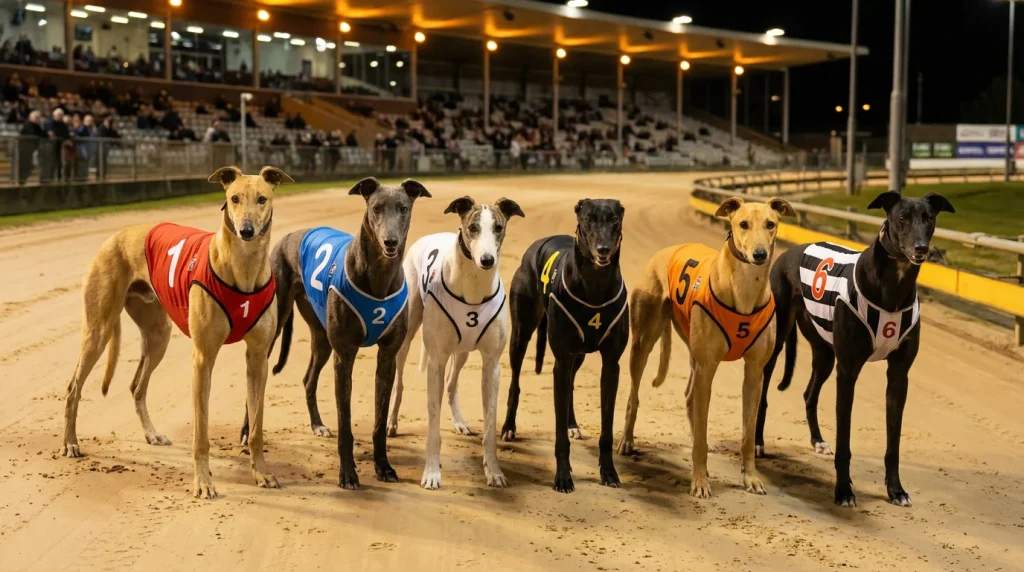
Every greyhound race in the UK is classified by grade, and understanding the grading system is the first step to reading a racecard with any confidence. It is the mechanism that keeps competition fair, ensures dogs of similar ability race against each other, and — critically for punters — provides one of the most reliable signals of a dog’s current level. A grade is not just a label. It is a compressed summary of where a greyhound sits in the hierarchy at its home track, and whether it is moving up, moving down, or holding steady.
The system is straightforward in principle but layered in practice. Grades run from A1 at the top to A12 at the bottom for standard middle-distance races, with separate prefixes for sprints, staying events, and hurdles. Overlay the distinction between graded and open races, the Category One through Category Three classifications for elite events, and the mechanics of how dogs are promoted or demoted, and you have a framework that rewards close attention.
The Grading Ladder: A1 to A12
The most common grading structure in UK greyhound racing uses the letter A followed by a number. A1 represents the highest level of graded competition at a given track; A12 (or whatever the lowest number used at that venue — not all tracks run to A12) represents the lowest. Most races on a standard evening card fall somewhere in the middle of this range, with A3 through A7 forming the bulk of the programme at many venues.
Each grade corresponds to a band of expected finishing times for the relevant distance at that specific track. The racing manager — the official responsible for assembling each meeting’s programme — assigns grades based on recent performances. A dog that consistently clocks 24.00 seconds over 415 metres might be graded A3 at one track, while a dog running 25.50 over the same distance would sit in A6 or A7. The exact time bands vary between venues because each track has different dimensions, surface characteristics, and going conditions. An A3 dog at Crayford was not directly equivalent to an A3 dog at Romford; the grades are relative to the track, not absolute across the sport.
The prefix letter changes for different race types. Sprints are designated with the letter S (S1, S2, S3, and so on), staying races use the letter D or a similar designation, and hurdle events have their own code. This means a dog might hold different grades at different distances: an A4 over 415 metres at its home track could be an S2 over 238 metres if it has proven sprint ability. Reading the racecard accurately requires noticing which grade applies to which distance.
The number of grades used varies by track and by the number of meetings held. Larger venues with more frequent racing tend to use a wider range of grades, while smaller tracks might compress the scale. Crayford, with its regular weekly schedule of evening, morning, and matinee meetings, used a reasonably broad grading ladder to accommodate the volume of dogs racing there. Smaller independent tracks might only run grades A1 through A6 because their pools of available runners are smaller.
Open Races and Category Levels
Above the graded system sits a separate tier: open races. These are not assigned a numerical grade. Instead, they are classified by category — Category One (OR1), Category Two (OR2), Category Three (OR3), or simply OR for uncategorised opens. Open races invite entries from across the country, not just from dogs based at the host track. This gives them a fundamentally different competitive profile compared to graded events, where the field is drawn from the local pool of runners.
Category One events are the pinnacle. The English Greyhound Derby, the St Leger, the Oaks, and a handful of other elite competitions fall into this bracket. There are roughly sixty Category One events staged each year across all UK tracks. These are multi-round competitions with heats, semi-finals, and a final, and they attract the best greyhounds in the country. For Crayford, the Golden Jacket and the Gold Collar both held Category One status — a significant distinction for a track of its size.
Category Two and Three events are a step below in prestige and prize money but still draw from a national pool of entries. Non-categorised open races (marked simply OR on the racecard) are one-off events that might be held on any evening’s card, mixing with the regular graded programme. They tend to attract higher-quality dogs than the top graded events at the same venue, offering punters an opportunity to see superior animals without waiting for a major competition.
The key point for bettors is that open races and graded races follow different dynamics. In a graded race, the field is theoretically balanced — six dogs of roughly equal ability competing at the same level. The outcome depends on trap draw, the break, running lines, and marginal form differences. In an open race, the quality gap between the best and worst runner can be substantial, and favourites tend to win more often. The favourite win rate in UK open races typically exceeds 40%, compared to around 35-36% in graded racing.
How Dogs Move Between Grades
Greyhound grades are not static. A dog’s grade is reviewed by the racing manager after every race and adjusted based on performance. The basic principle is simple: win and you go up; lose badly and you go down. The reality is more nuanced.
A dog that wins a race will typically be raised by one grade — from A5 to A4, for example. A dog that wins convincingly, by a wide margin with a fast time, might be raised by two grades. Conversely, a dog that finishes last or posts a significantly slower time than expected might be dropped by one or two grades. Dogs that finish in the middle of the pack without winning usually remain in their current grade for another run.
This system creates constant movement through the grading ladder. A young, improving greyhound might rise from A8 to A3 over the course of a few months as it matures and finds its best form. An older dog past its peak might gradually drift from A3 down to A6 or A7 as its times slow. The trajectory of a dog through the grades — up, down, or plateau — is itself a form indicator. A dog that has risen three grades in its last five runs is clearly improving and may continue to rise. A dog that has dropped two grades after a series of poor performances may be carrying an injury, losing fitness, or simply declining with age.
Grade changes are announced on the racecard and are visible in the form lines. When a dog’s previous run was in a different grade from the current race, the change is noted. Experienced punters pay close attention to these movements. A dog dropping in grade is not necessarily a poor prospect — it may have been competing above its level and is now meeting more suitable opposition. This is one of the most common sources of value in greyhound betting: a dog that was outclassed at A3 but is well capable of winning at A5, offered at longer odds than its true ability warrants because its recent form line shows a string of defeats at the higher level.
Grade Signals for Bettors
The grading system is a ready-made form filter if you know how to read it. Three patterns are worth watching consistently.
First, the drop-in-class angle. A dog moving down two or more grades from its recent races is often facing weaker opposition than it has encountered recently. If the drop is caused by a single poor run — a crowding incident, a slow start from an unfavourable trap — rather than a genuine decline in ability, the dog may represent significant value. The key is to check why the grade dropped: was it a one-off misfortune, or is there a pattern of declining times?
Second, the rising-star pattern. Young dogs that are climbing the grading ladder quickly are, by definition, improving. They are beating the opposition at each level and being promoted. The risk is that they eventually reach a grade where the competition is too strong, but until that ceiling is hit, backing an upwardly mobile greyhound can be profitable. Look for dogs that have won two or three of their last four starts with progressively faster times.
Third, the grade-distance mismatch. A dog graded A3 over 415 metres might be asked to race at a different distance — say 592 metres — where its grade is less relevant. Distance changes disrupt the grading system because a dog’s ability does not translate uniformly across trips. A sharp sprinter graded A3 at 415m might struggle badly at 592m against dogs with genuine stamina. The racecard will show the grade for the listed distance, but if the dog’s form is almost entirely at a different distance, the grade may not reflect its actual chance in the race.
The Grade Tells Half the Story
Grades are essential but they are not sufficient. A grade tells you the approximate level of competition a dog is facing. It does not tell you about the trap draw, the dog’s early speed, its running style, or the going conditions on the night. Two A4 dogs in the same race might have entirely different profiles: one a front-runner that dominates from the traps, the other a closer that relies on a strong finish. The grade makes them nominal equals. The racecard’s detail — bend positions, split times, remarks — separates them. Treat the grade as the starting point of the analysis, not the conclusion.