Understanding Greyhound Odds and How They Move
Best Greyhound Betting Sites – Bet on Greyhounds in 2026
Loading...
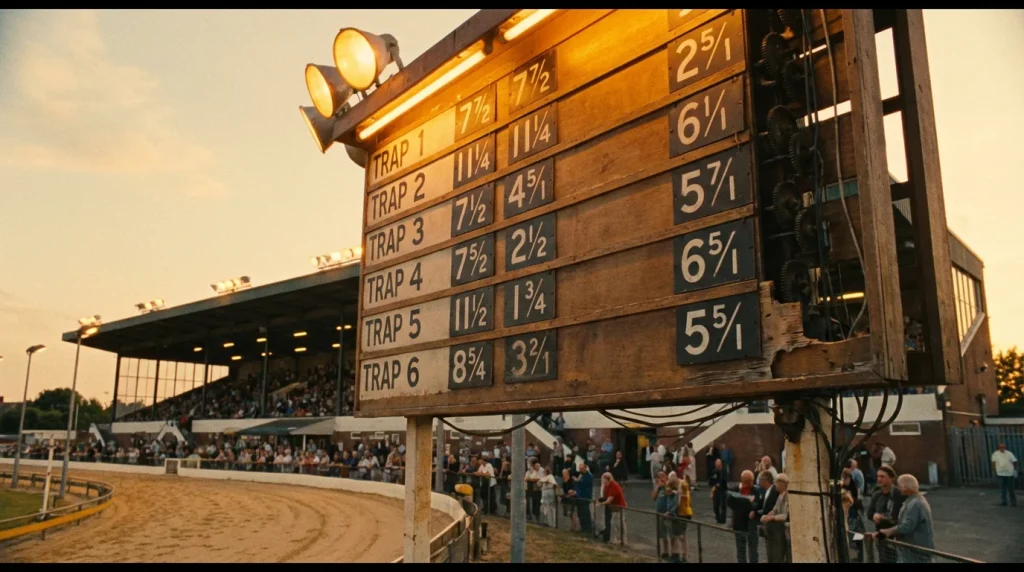
Odds in greyhound racing are a compressed opinion. They reflect what the market believes about each dog’s chance of winning — filtered through the bookmaker’s margin, the weight of money from other punters, and the trading team’s assessment of the form. When the price on a dog shortens from 5/1 to 3/1 in the twenty minutes before a race, that movement is not random. It is information. Someone — or many someones — is telling you they think that dog is more likely to win than the original price suggested. Whether they are right is another question, but learning to read the message is the first step towards acting on it.
Greyhound odds operate on the same principles as any betting market, but the specific dynamics differ from horse racing in ways that matter. Smaller fields, shorter time between card publication and race-off, thinner markets, and a higher proportion of bets placed through bookmaker shops rather than exchanges all shape how prices are formed and how they move. Understanding these mechanics turns the odds column from a static list of numbers into a live feed of market intelligence.
How Odds Are Set for Greyhound Races
The initial prices for a greyhound race — the tissue prices — are typically set by the bookmaker’s trading team or, in some cases, derived from the track’s racing manager’s assessment. Tissue prices are the opening odds that appear when the racecard is first published, usually several hours before the race. They reflect a preliminary judgement of each dog’s chance based on recent form, calculated time, trap draw, running style, and the perceived strength of the opposition.
At this stage, the odds are theoretical. No money has been wagered, and the prices represent an educated estimate rather than a market-tested consensus. The tissue is designed to be roughly accurate — close enough to reality that the bookmaker doesn’t expose itself to massive liability — but it is not precision-engineered. There is room for error, and it is in that room that value exists for punters who do their own form analysis before the market sharpens.
Once the tissue is published, the market opens and bets begin to flow. Bookmakers adjust their prices in response to the money: if a particular dog attracts heavy backing, its price shortens; if another dog is being ignored, its price drifts. This process is continuous, with prices updating every few minutes (or faster on digital platforms) as the race approaches. By the time the traps open, the odds have been shaped by the collective activity of every punter who has bet on the race — from the casual shop bettor placing a two-pound accumulator to the serious form student staking a calculated amount on a single selection.
The overround — the bookmaker’s built-in margin — is present from the tissue onwards. In a perfectly fair market, the implied probabilities of all six dogs would sum to 100%. In practice, they sum to 115-125% or more, with the excess representing the bookmaker’s theoretical profit margin. This overround is distributed unevenly across the field: favourites tend to carry a smaller share of the excess, while outsiders carry a larger share. This means that longshots in greyhound racing are, on average, slightly worse value than favourites relative to their true probability — a pattern known as the favourite-longshot bias.
Market Movers and Drifters
A market mover is a dog whose price shortens significantly between the tissue and the off. A drifter is the opposite: a dog whose price lengthens, indicating that the market is less confident in its chances than the tissue suggested. Both movements carry information, though neither is infallible.
Significant market moves in greyhound racing tend to be driven by one of three factors. The first is informed money — bets placed by punters with specific knowledge, whether from their own form analysis, connections to a trainer, or observation of the dog in recent trials. When a dog’s price shortens sharply in the final fifteen minutes before a race, it is often because someone with a strong opinion has backed it heavily enough to move the market. The second factor is follow-the-money behaviour: other punters see the price shortening and back the same dog, creating a cascade that amplifies the initial movement. The third is bookmaker risk management — the trading team shortens the price proactively to limit their exposure on a dog that they judge to be underpriced.
Drifters are equally instructive. A dog whose price moves from 3/1 to 5/1 is being abandoned by the market. The reasons might include late information — a report of the dog looking flat at the track, a change in going that doesn’t suit its style, or simply a reassessment of the form that makes the original tissue look too generous. Not every drifter loses, but the trend is clear: dogs that drift significantly underperform their original tissue price on average.
Tracking market movements is most useful when combined with your own pre-race assessment. If your form analysis says a dog should be 4/1 and the market has moved it from 6/1 to 4/1, the market is confirming your view — and the value may have already gone. If your analysis says 4/1 but the market is drifting the dog out to 8/1, something is happening that your form reading may have missed, and caution is warranted. The most interesting scenario is a dog that your analysis rates highly but which the market is not backing — a dog that stays at its tissue or drifts slightly while you believe it should be shorter. That disagreement between your assessment and the market is where selective betting finds its edge.
Starting Price: How It’s Calculated
The starting price is the official odds at which a dog is returned when the traps open. In UK greyhound racing, the SP is determined by a process that involves the on-course bookmakers’ boards — the prices displayed at the track at the moment the race begins. For races where on-course betting is limited or absent (many BAGS meetings, for instance), the SP is calculated from an industry-standard formula based on the prices offered by a panel of licensed bookmakers.
The SP matters because it is the default settlement price for bets placed at starting price rather than at a fixed early price. It is also the benchmark against which Best Odds Guaranteed promotions are measured: if you took an early price and the SP is higher, BOG pays you at the SP. Understanding that the SP is a snapshot of the market at one specific moment — the off — rather than an average or a median is important. A dog whose price has been volatile, swinging between 3/1 and 5/1 in the final minutes, could return an SP at either end of that range depending on exactly where the market sat when the traps opened.
For most practical purposes, the SP is a reliable reflection of the market’s final opinion on each dog’s chance. It incorporates all the money that has been wagered, all the market moves, and the bookmaker’s final risk adjustment. It is not always the best price available — fixed early prices or exchange odds can both beat the SP in individual races — but it is the price of record and the foundation of most post-race analysis.
Spotting Value Before the Market Closes
Value, in betting, exists when the odds offered on an outcome are higher than the true probability of that outcome occurring. A dog with a 25% chance of winning (fair odds: 3/1) priced at 5/1 represents value. A dog with a 25% chance priced at 2/1 does not, no matter how likely it is to win. The concept is simple. The execution is hard, because estimating true probability requires better information or better analysis than the market average.
In greyhound racing, value opportunities tend to cluster in specific situations. Early-morning prices on BAGS meetings can be less efficient than evening-card prices, because less analytical attention is focused on daytime racing. Dogs returning from a break, whose recent form is absent from the racecard, are often mispriced because the market defaults to caution — either overestimating the risk of a comeback run or underestimating the dog’s residual ability. Kennel moves, as discussed elsewhere, create a transitional period where the new grading may not accurately reflect the dog’s true level.
The practical method is to form your own price for each dog before looking at the market. Assess the form, the trap draw, the pace map, the going, and any other relevant factors, then estimate a probability of winning. Convert that probability to odds. If the market is offering longer odds than your estimate, you have a potential value bet. If the market is shorter, the value is not there. This discipline — pricing before you see the price — prevents the common error of rationalising a bet after the fact, where you see a price you like and then find reasons to justify it.
The Price Is a Conversation — Listen
Odds are not fixed truths. They are a negotiation between what the market knows and what it doesn’t. Every price movement is a sentence in that negotiation — sometimes confident, sometimes uncertain, sometimes wrong. The punter who listens to what the market is saying, compares it to their own analysis, and bets only when the two disagree in their favour is the punter who survives long enough to profit. The price is always talking. The skill is knowing when it is worth answering.