Golden Jacket Greyhound Race: History and Winners
Best Greyhound Betting Sites – Bet on Greyhounds in 2026
Loading...
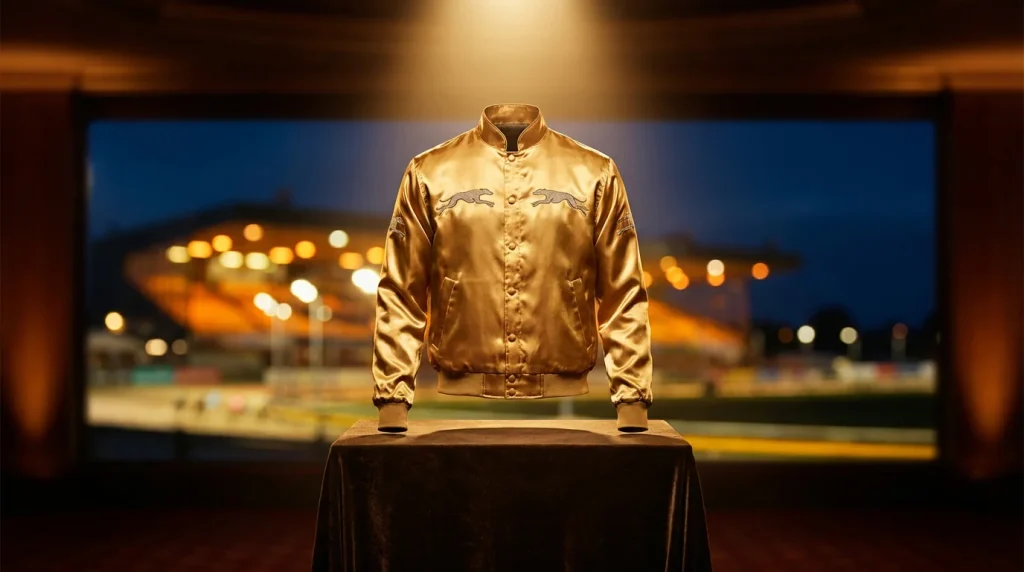
The Golden Jacket is one of British greyhound racing’s most enduring competitions — and one that keeps losing its home. Established in 1975, it has survived track closures, format changes, sponsorship shifts and decades of declining attendance at greyhound venues. Through it all, the race has maintained its status as a Category One event, sitting alongside the English Greyhound Derby and the St Leger in the upper tier of the sport’s calendar. Its trajectory mirrors the broader story of UK greyhound racing: a prestigious competition forced to adapt as the infrastructure around it contracts.
For most of its modern history, the Golden Jacket was synonymous with Crayford. The race arrived at the Kent-border stadium in 1987 and stayed there until the venue closed in January 2025 — a span of nearly four decades that gave Crayford its single most recognisable competition and the Golden Jacket a stable, well-regarded home. That stability is now gone, and the race faces an uncertain future for the first time in a generation.
Origins at Harringay
The Golden Jacket was first staged at Harringay Stadium in north London, one of the grand old arenas of British greyhound racing. Originally created as a competition to be broadcast on ITV’s World of Sport afternoon sports programme, it was an 18-runner invitation event staged over 660 metres. Harringay, which also hosted ice hockey, boxing and music events, provided the kind of venue that lent the competition instant credibility. During its years at Harringay, the Golden Jacket established itself as a prestige event — not quite on the level of the Derby, but comfortably in the next tier of importance.
Harringay’s closure in September 1987 left the Golden Jacket homeless. The stadium had been a cornerstone of London’s greyhound scene, and its loss sent several competitions scrambling for new venues. The Golden Jacket was temporarily relocated to Hall Green in Birmingham for one running, then moved to Monmore. Neither venue offered a long-term solution. Hall Green was already hosting its own major events, and Monmore, while a strong track, was geographically distant from the race’s London roots. The competition needed a permanent home, and it found one almost immediately when Crayford’s newly rebuilt stadium opened its doors.
The timing was fortuitous. Crayford had just completed its transformation from the old Crayford and Bexleyheath site into a modern, purpose-built racing venue. The stadium’s owners, Ladbrokes, were actively seeking marquee events to draw attention to the new facility, which had opened on 1 September 1986. The Golden Jacket was the perfect fit: a prestigious race looking for a home, and a new track looking for prestige. The partnership worked for nearly four decades.
The Crayford Years: 1987–2024
The first Golden Jacket at Crayford was staged in 1987. It was a symbolic start that set the tone for a competition which would become deeply embedded in the stadium’s identity.
Throughout the late 1980s and 1990s, the Golden Jacket was run as a televised event with exposure through the bookmakers’ shop network. This gave the race a reach far beyond the stadium’s terraces. Punters across the country could watch the heats, semi-finals and final in their local Ladbrokes or Coral shop, building familiarity with the runners and generating significant betting turnover. The television deal was a commercial lifeline for both the race and the track, providing revenue and visibility that a live gate alone couldn’t match.
The competition was traditionally run over 714 metres at Crayford, placing it firmly in the staying category. This distance favoured greyhounds with stamina and tactical awareness rather than pure sprint speed, and the fields often featured experienced campaigners rather than flashy youngsters. The staying nature of the race gave it a distinct character: Golden Jacket contests tended to be tactical affairs decided in the final two bends rather than explosive front-running dashes settled by the first turn.
Over the years, the race attracted some notable performers. The quality of the field varied with the broader health of the sport — smaller trainer pools in later decades inevitably affected the depth of competition — but the best runnings drew genuine class. The Golden Jacket’s prize money reflected its Category One status. The winner’s purse stood at twenty thousand pounds in its later years, which was substantial for greyhound racing though modest compared to the sport’s bigger prizes in Ireland or the English Derby itself. For many trainers operating at Crayford, the Golden Jacket represented the biggest payday on their home track’s calendar.
In 2024, the final Golden Jacket staged at Crayford was won by Dazl Rolex, trained by Rick Holloway. It was a notable detail that added a fitting narrative flourish to what turned out to be the race’s farewell at the venue.
Notable Winners
Across its decades at Crayford, the Golden Jacket produced a roster of winners that charted the changing landscape of UK greyhound racing. The early winners in the late 1980s came from the sport’s broader golden age, when multiple London-area tracks were still active and the talent pool ran deep. As tracks closed through the 1990s and 2000s — Wimbledon, Catford, Walthamstow — the base of competing greyhounds contracted, but the quality of Golden Jacket finalists remained high because it drew entries from across the country rather than relying solely on local runners.
Several dogs used the Golden Jacket as a springboard to wider recognition. A strong performance in the heats or a clear victory in the final could elevate a greyhound’s reputation and increase its value for breeding purposes after retirement. Conversely, some high-profile entrants arrived at Crayford having already established themselves in other major competitions, using the Golden Jacket to add another line to their career record.
The race also highlighted certain trainer-kennels that built their operations around the staying distances. Trainers with a knack for preparing greyhounds for 714m at Crayford’s tight circuit — a specific skillset that required knowledge of the track’s bends, surface characteristics and pace dynamics — won the Golden Jacket repeatedly. This kind of specialisation was a recurring feature of UK greyhound racing: trainers who understood their home track’s quirks often dominated the marquee events staged there, much as a horse racing trainer might have a particular course where their runners consistently outperformed expectations.
The full list of Golden Jacket winners runs to several dozen names. Cataloguing them all would require access to complete historical records maintained by the Greyhound Board of Great Britain, but the pattern is clear: the competition consistently attracted the best staying greyhounds in the country, and the roll of honour includes dogs from both major professional kennels and smaller operations that produced the occasional top-class stayer.
Future of the Golden Jacket
Crayford’s closure in January 2025 left the Golden Jacket in limbo. Entain, the parent company of Ladbrokes and the former operator of Crayford Stadium, has not confirmed a new venue for the race. The most likely scenario is that the race migrates to another licensed UK track with appropriate staying distances and infrastructure. Romford, the nearest surviving London-area venue, runs over different distances and would require a format adjustment. Hove, Monmore and Towcester are all candidates, each with their own advantages and limitations.
It is also possible that the race simply ceases to exist. Greyhound racing history is littered with competitions that died alongside their host venues. The Scurry Gold Cup, the Laurels at Wimbledon, the Grand Prix at Walthamstow — all prestigious races that ended when their tracks closed. The Golden Jacket has survived one displacement before, moving from Harringay to Crayford, but that transition happened at a time when the sport was in better health and alternative venues were more plentiful. In 2026, the options are fewer and the commercial incentives for a track to adopt an orphaned competition are weaker.
A Race Without a Track
The Golden Jacket has outlived every stadium it has called home. Harringay is long gone, demolished and redeveloped. Crayford’s floodlights are now dark, the traps empty, the sand still. Whether the race finds a third home depends on decisions that have yet to be made — by racing administrators, by track operators, by the broader economics of a sport that loses venues faster than it gains them. The name carries weight. The history is real. But a race needs a track, and tracks, in British greyhound racing, are a diminishing resource.