Crayford Greyhound Race Distances and Track Layout
Best Greyhound Betting Sites – Bet on Greyhounds in 2026
Loading...
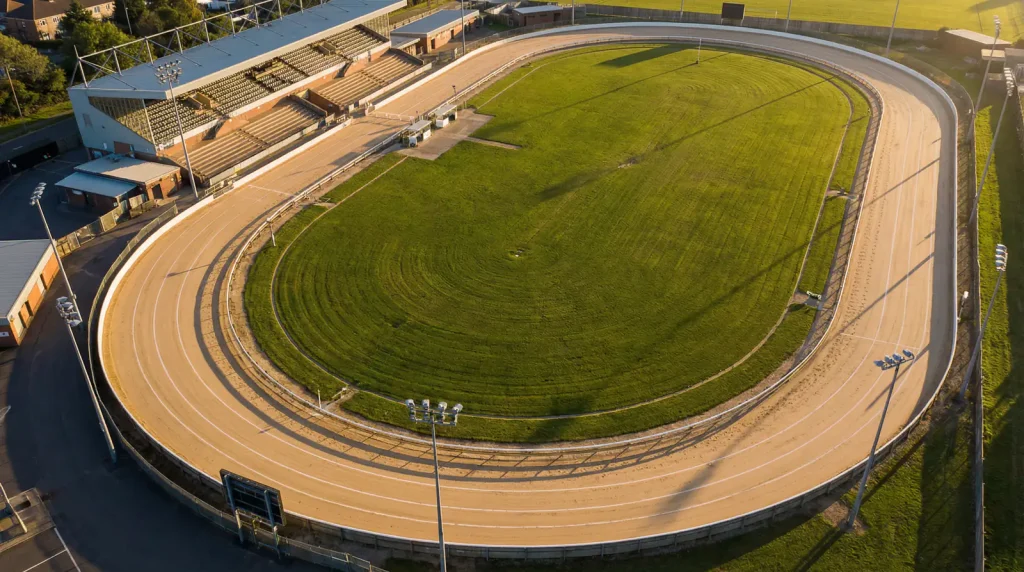
Five race distances on a 334-metre circuit — each one demanded different skills from a greyhound. Crayford Stadium offered sprints as short as 238 metres and marathons stretching to 946, all on the same tight, right-handed sand oval. A dog that dominated the sprint could be hopelessly outclassed at the staying trip, and the reverse was equally true. The track’s compact dimensions meant that every distance carried its own tactical character, shaped not just by how far the dogs ran but by how many bends they negotiated and how quickly the first turn arrived.
Understanding these distances was not optional for anyone serious about interpreting Crayford results. A 23.5-second calculated time over 415 metres told a completely different story from the same number recorded over 238. Distance context turned raw data into meaningful form analysis, and without it, comparing performances across meetings or across dogs was guesswork dressed up as method. Since the stadium closed in January 2025, these distances are now fixed history — but they remain the essential reference for anyone studying the archive or applying Crayford-specific knowledge to other UK tracks.
The 334m Sand Circuit
Crayford’s all-sand racing surface measured 334 metres in circumference, making it one of the tighter ovals on the UK greyhound calendar. For context, Towcester’s circuit stretches to 451 metres, and Romford sits at approximately 380. The smaller the circumference, the sharper the bends — and at Crayford, those bends were tight enough to punish any runner that couldn’t hold its line under centrifugal pressure.
The track ran right-handed, meaning dogs travelled anti-clockwise when viewed from inside the circuit. This placed a premium on a greyhound’s ability to balance through left-leaning turns, with the inside rail as the most economical route. A Swaffham-type outside hare provided the lure, and its position occasionally drew dogs wide in the closing stages as competitive instinct overruled efficient running lines.
The defining feature of the layout was the 77-metre run from the starting traps to the first bend. Seventy-seven metres is short. At many UK tracks, the run-up exceeds 100 metres, giving dogs time to find their position and settle into stride before the opening turn. At Crayford, a dog that was half a length behind after the first two seconds of a race could find itself boxed in entering the bend with no room to manoeuvre and no straight to recover on. This compressed run-up was the single most influential characteristic of Crayford’s racing. It made trap draw critical, rewarded early speed disproportionately, and ensured that the first bend determined the shape of most contests before the field had covered a quarter of the total distance.
The sand surface was consistent and well-maintained, producing reliable going conditions through most of the year. Sand drains faster than grass and is less vulnerable to heavy rainfall, so Crayford could race through weather that might force postponements at turf venues. Track staff recorded going adjustments before each meeting — a numerical correction (positive for slow conditions, negative for fast) that fed directly into every dog’s calculated time. A going figure of +10, for instance, added a tenth of a second to normalise the winning time against standard conditions.
Sprint: 238m
The 238-metre sprint was Crayford’s shortest trip — a raw test of acceleration with minimal tactical complexity. Dogs covered the distance in roughly 14 to 15 seconds, and races were frequently decided before the field reached the first bend. At this trip, there was almost no time for a dog to recover from a poor break. The form figures for 238m races showed markedly less variation in finishing positions than longer events. The quick dog won. The slow dog lost. Traffic played a role but a reduced one, because the field had fewer opportunities to bunch together.
Trainers entered their sharpest breakers in sprint races, and the grade of these events reflected that specialisation. A dog with exceptional trap speed but limited stamina could sustain a productive career running almost exclusively at 238m. Betting on sprints was, accordingly, an exercise in identifying early pace: the dog with the best recent split time, drawn in a favourable trap, was usually the logical selection. Upsets happened less frequently here than at any other distance on the card.
Standard Distances: 415m and 592m
The 415-metre trip was the backbone of Crayford’s schedule. More races were run at this distance than at all the others combined, and the grading system was built primarily around it. Dogs typically completed 415m in around 25 to 26 seconds, covering roughly one and a quarter laps of the circuit — four bends, four opportunities for interference, and four chances for the trap draw to help or hinder a runner.
At this trip, form reading became genuinely multi-layered. A dog’s finishing time mattered only when adjusted for going and assessed in context of its bend positions. A runner that led at every call and won by two lengths had a fundamentally different profile from one that trailed last at the first turn and finished strongly to grab second. Both might clock the same calculated time, but their racing styles — and their prospects next time out — were completely different. The racecard abbreviations captured this nuance: bend positions listed as 1-1-1-1 described a front-runner, while 5-4-3-2 pointed to a dog with a strong finish but poor early speed.
The 592-metre trip added another lap and two more bends. It was Crayford’s middle-distance test, sorting dogs that had speed from those that had speed and stamina. Races lasted approximately 37 to 39 seconds, and the field typically strung out more than at 415m as the less talented runners fell away through the second circuit. For bettors, this distance rewarded patience in the form study: a dog that consistently held its bend position through the later stages of a 592m race was demonstrating genuine staying power — a quality that could be exploited when that dog dropped back to 415m, where its reserves might prove too much for the pure sprinters in the closing stages.
Staying: 769m and Marathon 946m
At 769 metres, Crayford entered staying territory. Races involved multiple full circuits and tested a greyhound’s endurance as much as its pace. Finishing times stretched into the high 40s or low 50s, and the contests had a different rhythm: tactical positioning through the middle of the race — conserving energy on the bends, settling into a comfortable position in the pack — mattered as much as the initial break.
This distance also hosted some of Crayford’s most prestigious events. The Golden Jacket and other major staying competitions attracted a different calibre of runner: typically older, more experienced animals with proven records across extended trips. Trainers brought their staying specialists to these cards, and the racecards for 769m races tended to feature dogs with longer, more established form histories than the sprint regulars.
The 946-metre marathon was the rarest event on the calendar. It demanded extraordinary endurance from animals that are, by breeding, sprint specialists. A 946m race took well over a minute, covering nearly three full laps. The tight 334-metre circumference made marathons more physically demanding than the distance alone suggested, because the sharp bends placed continuous lateral stress on joints and muscles. Few greyhounds had the combination of stamina, durability and racing intelligence to compete effectively at this trip. Fields were often smaller than at shorter distances, and the form was harder to assess because dogs ran these races so infrequently that the sample of prior performances was thin.
For bettors, staying and marathon events offered both opportunity and difficulty. Smaller fields meant fewer variables but also constrained each-way and forecast markets. A dog with three recent 415m runs provided a robust form line; a dog with one 946m outing three months ago offered almost nothing to work with. Those willing to dig deeper — comparing split times across distances, adjusting for the greater physical demands of the longer trip — could find value that the casual punter missed entirely.
Numbers That No Longer Update
Every race distance at Crayford now carries a track record that will stand permanently. No future greyhound will run 238 metres on that sand oval in 14-point-something seconds. No staying specialist will post a new best over 769 metres under those floodlights. The times are fixed and the archive is complete.
That permanence has a practical use. A closed dataset is a clean dataset. There are no new outliers to distort the averages, no pending form figures to wait for. Anyone analysing Crayford’s distance-specific results can do so with the confidence that the numbers are final. For the study of how track layout, distance and dog type interact — a question that applies to every greyhound venue in the country — Crayford’s complete record is as useful a teaching tool as any still-operating track can offer. The floodlights are off, but the data still runs.