Crayford Stadium: The Full History of London's Greyhound Landmark
Best Greyhound Betting Sites – Bet on Greyhounds in 2026
Loading...
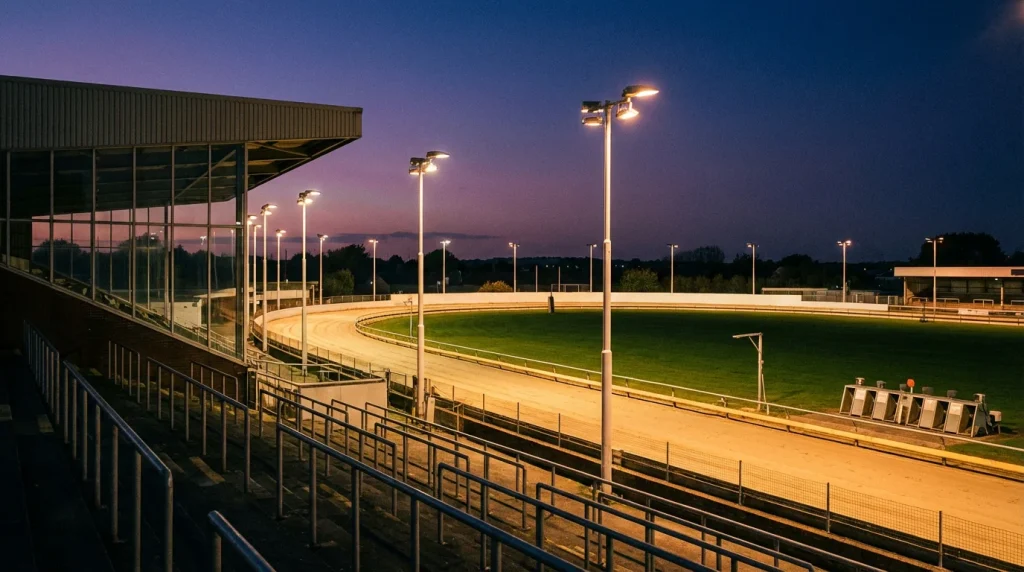
Ninety Years on Five Acres of Sand
Dog racing arrived in Crayford before the Second World War and outlasted nearly everything around it — except the economics. The site in the London Borough of Bexley hosted some form of racing from 1932 to 2025, making it one of the longest-serving greyhound venues in the south-east of England. Two stadiums stood on the same general plot of land across that span: the original Crayford and Bexleyheath Stadium, a pre-war track that grew piecemeal over five decades, and the purpose-built Crayford Stadium that replaced it in 1986 and ran for another thirty-eight years.
The story of Crayford is a compressed history of British greyhound racing itself. The early decades were defined by improvisation and local enterprise — a speedway track repurposed for dogs, a stadium built on fairground land, trainers employed by the track in a system borrowed from America. The middle period was a golden era: Ladbrokes money, television coverage, Category One competitions migrating in from closed London rivals, and a new stadium that drew comparisons to a modern betting shop crossed with a leisure complex. The final chapter was decline — meetings cancelled for lack of runners, four-dog races where six were scheduled, terraces emptying, and a corporate owner concluding that the numbers no longer worked.
Between the first race on Easter Monday 1932 and the last meeting on 19 January 2025, Crayford produced thousands of racecards, tens of thousands of results, and a record of greyhound form that remains in the databases of GBGB, At The Races, Timeform, and others. The stadium has gone. The data has not. This is the full history of both.
1932–1985: The Crayford and Bexleyheath Years
Wilson Greyhound Racing Track Ltd built the first oval in 1932, on land that had briefly hosted speedway. The site — known as Crayford Fairfield — had been used for travelling fairs for centuries before the Bexleyheath and District Motorcycle Club laid a grass speedway track there in 1930. The motorcycle racing proved difficult to organise, and by 1931 the club was looking for alternatives. Wilson stepped in, constructed a 450-yard circuit around the existing grass track, and opened for greyhound racing on Easter Monday 1932.
Speedway returned alongside the dogs later that year, with a new cinder track inside the greyhound oval. For the next five years, the venue operated as a dual-purpose facility under the name Crayford Speedway Stadium. In 1937, the stadium was substantially rebuilt at a cost of fifty thousand pounds by builders W and C French. The new venue dropped the speedway branding, becoming the Crayford and Bexleyheath Greyhound Stadium, and the first greyhound meeting at the rebuilt track took place on Saturday 10 July 1937.
The next two decades saw Crayford establish itself as a reliable mid-tier venue in the London greyhound circuit. Henry Parsons was employed in 1955 as the track’s sole trainer, responsible for all greyhounds racing there — a common arrangement at smaller tracks before the era of contracted independent trainers. Parsons’s dogs provided some early highlights: Malanna Mace won the 1952 Test and the Northern 700, reaching the St Leger final in the process.
Ownership changed in 1964 when the Totalisator Holdings Group, which already ran tracks at Gosforth, Leeds, and Brough Park, acquired the stadium from Northumbrian and Crayford Trust Ltd. THG became the second-largest greyhound operator in Britain behind the Greyhound Racing Association. Under new ownership, Crayford introduced its first major competition — the Crayford Vase in 1967 — and constructed a grandstand. A new speedway circuit was added inside the greyhound track the same year, and the Crayford Kestrels speedway team operated from 1968 until 1983.
Crayford also pioneered a system that would become standard across the industry. It was the first UK track to adopt the American model of employing contracted trainers instead of keeping kennel staff as direct employees. Bill Westcott and former Arms Park trainer Paddy Coughlan were among the first to train independently from their own premises. This system gave trainers more autonomy and spread the financial risk away from the track operator — a model that every GBGB venue would eventually follow.
By the early 1980s, however, the original stadium was showing its age. The Crayford Kestrels relocated for the 1984 season, and news emerged that Ladbrokes had plans for a major redevelopment. The proposal was ambitious: sell fifteen of the twenty-acre site to Sainsbury’s for a supermarket, and rebuild the greyhound stadium on the remaining five acres. Racing at the old Crayford and Bexleyheath Stadium ended on 18 May 1985. The grandstand, the terraces, the peat track that workmen claimed had once yielded a three-hundred-year-old skeleton during digging — all of it was demolished. Fifty-three years of history levelled to make way for a supermarket and a fresh start.
1986: The Rebuild and a New Stadium
Ladbrokes spent sixteen months turning five acres into a modern racing venue. The new stadium occupied the western portion of the original twenty-acre site, physically separated from the Sainsbury’s superstore that now sat where the old grandstand had been. The press claimed it was the first purpose-built greyhound stadium in thirty years, though several tracks — including Nottingham and Reading — had been constructed more recently. What Crayford lacked in historical priority, it made up for in ambition.
The grand opening took place on 1 September 1986. The Mayor of Bexley and Ladbrokes Chairman Cyril Stein cut the ribbon on a facility that looked nothing like a traditional dog track. The new stadium featured a twin-tier, glass-fronted covered stand, a restaurant seating 138, two bars, and — in a nod to the leisure aspirations of the era — a sports hall complex, a fitness area, and a swimming pool. The Bexleyheath part of the name was dropped, partly because the stadium now sat on a different portion of the land and partly because “Crayford” was simpler.
The all-sand circuit measured 334 metres in circumference — compact by UK standards — with a right-handed configuration and an outside Sumner hare. Racing distances were set at 380, 540, 714, and 874 metres. The tight circuit and short run to the first bend meant inside trap draws carried a significant advantage, particularly over the 380-metre sprint distance. This became one of Crayford’s defining characteristics: a track where trap bias was pronounced and where fast breakers from inside boxes dominated the results.
The former operations manager Diana Illingworth, who was present on opening day and worked at the stadium for over forty years, later described the early atmosphere in stark terms. From the minute the doors opened, the place was packed. The new Crayford was designed as a giant betting shop as much as a racing venue, and it worked. Ladbrokes shops across the south-east funnelled customers toward the afternoon meetings, and the evening cards drew steady crowds throughout the late 1980s and into the 1990s. Several trainers from the old Crayford and Bexleyheath era returned — Dink Luckhurst, John Gibbons, and Terry O’Sullivan among them — while others, like Linda Mullins and John Honeysett, moved to other tracks.
The Golden Era: Major Races Move to Crayford
When Harringay closed, the Golden Jacket needed a home. Crayford opened its doors. The arrival of a Category One competition in 1987, barely a year after the stadium opened, transformed Crayford from a local venue into a track with national relevance. Over the next three decades, the stadium accumulated a portfolio of prestige races that no track of its size should logically have held — a consequence of bigger London venues closing one after another and their competitions needing somewhere to land.
The Golden Jacket at Crayford
The Golden Jacket was inaugurated at Harringay in 1975 as an afternoon event designed for ITV’s World of Sport programme. Run over a staying distance, it quickly became one of greyhound racing’s marquee competitions. When Harringay closed in 1987, the event moved temporarily to Hall Green and then Monmore Green, but neither proved a permanent fit. Crayford took it on in 1987 and ran it every year until the stadium’s closure — a thirty-seven-year residency that made the Golden Jacket synonymous with the track.
Run over 714 metres on sand, the final carried a winner’s prize that rose from modest beginnings to twenty thousand pounds under the Premier Greyhound Racing banner by the 2020s. The competition attracted entries from trainers across the country, with Hove-based handlers proving particularly successful — Derek Knight won it five times, Brian Clemenson three. Bobs Regan and Wexford Minx each retained the title in consecutive years. In 2007, Spiridon Louis — trained by Crayford-based Lorraine Sams — won the Greyhound of the Year award after a campaign that included the St Leger, TV Trophy, and Regency, cementing both the dog’s reputation and the track’s status as a venue capable of producing elite performers.
The final Golden Jacket was won in 2024 by Dazl Rolex, trained by Ricky Holloway — the first home-trained winner since Spiridon Louis’s era. It was a fitting final chapter: a local trainer winning the track’s signature race in its penultimate year of existence.
Gold Collar, Kent St Leger and Grand National
The Golden Jacket was the headline act, but Crayford’s competition portfolio extended further. The Gold Collar — originally run at Catford from 1933 — moved to Belle Vue after Catford closed in 2003, was discontinued in 2009, and then resurrected at Crayford in 2015. Run over 540 metres, it gave the track a second Category One event. Pure Patches won the Gold Collar in 1998 and went on to reach the English Greyhound Derby final at Wimbledon the following year, illustrating the quality of dog that the Crayford staying events attracted.
The Kent St Leger, also run over 714 metres, added a third Category One to the calendar. Together with the Guys and Dolls competition — introduced in 1997 — these events gave Crayford a racing programme that punched well above its weight for a 334-metre sand circuit in outer London.
Hurdle racing was another consistent strength. Crayford’s Grand National — its own hurdle event, not to be confused with the greyhound Grand National held at other venues — produced notable winners. Breeks Rocket won it for trainer Dink Luckhurst in 1988, Dynamic Display repeated the feat for Barry O’Sullivan in 1996, and Plane Daddy, trained by Gemma Davidson, claimed it in 2010. The Champion Hurdle arrived at Crayford in 2023, adding yet another event to a hurdles programme that had become one of the strongest in the country.
Track Records and Benchmark Performances
The fastest greyhounds to run Crayford’s five distances set marks that can never be broken. With the stadium closed, these records are now permanently frozen — a final set of numbers etched into the databases that no future performance can challenge.
Crayford’s distances ran from the 380-metre sprint through to the 874-metre marathon, with 540 and 714 metres covering middle distance and staying categories. The 334-metre circumference and tight bends meant that Crayford times were not directly comparable to those at larger tracks. A dog running 29.20 at Crayford over 480 metres — a distance occasionally used for specific events — was not running the same race as one posting 29.20 at Romford or Sheffield, where the circuits are more galloping and the bends less acute. Crayford was a speed-and-break track: fast starters thrived, and dogs with strong early pace but limited stamina could win over shorter trips that would have exposed them on a bigger circuit.
Several performances across the decades stand out as benchmarks. Spiridon Louis’s 2007 campaign, in which the black-and-white dog won multiple Category One events on the way to Greyhound of the Year honours, demonstrated that a dog primarily trained and raced at Crayford could compete at the highest national level. Corduroy, trained by John Honeysett, reached the 1980 English Greyhound Derby final — a remarkable achievement for a dog emerging from what was then the old Crayford and Bexleyheath track, before the rebuild. Honeysett repeated the feat the following year with Clohast Flame. In the era of the new stadium, performances in the Golden Jacket and Gold Collar established Crayford’s track records over staying distances, while sprint records were typically set in graded racing where the tight circuit favoured explosive breakers.
Track records in greyhound racing carry a different weight from those in human athletics. They are influenced by going conditions, hare running, and the specific calibre of competition present on a given night. A record set on fast going at an evening meeting in midsummer is not the same achievement as one set on heavy sand in January. Nonetheless, the records at Crayford over 380 and 540 metres remained competitive benchmarks within the GBGB circuit, and the staying records over 714 metres reflected the quality of the Golden Jacket and Kent St Leger fields.
For form students working with Crayford’s historical data, the track records serve as reference points. A graded A3 dog running within a second of the track record over 540 metres was, by definition, performing at open-class level. These benchmarks still matter for anyone analysing Crayford form retroactively or comparing the track’s output to other venues.
Decline and the Entain Decision
The warning signs were visible for years: cancelled meetings, four-dog races, empty terraces. Crayford’s decline was not a sudden event but a slow contraction that mirrored the broader erosion of British greyhound racing’s infrastructure over the past two decades. In the 1940s, there were seventy-seven licensed tracks and over two hundred independent venues across the United Kingdom, thirty-three of them in London alone. By 2025, London was down to Romford. Crayford was simply the latest casualty in a pattern that had already consumed White City, Wimbledon, Walthamstow, Catford, and Hackney.
The specific factors that undermined Crayford were both structural and local. The shift from on-course attendance to off-course betting — accelerated by online bookmakers and live streaming — reduced the commercial rationale for maintaining a physical stadium. Crayford adapted by adding morning meetings for the BAGS (Bookmakers Afternoon Greyhound Service) circuit and signing a deal with SIS in 2018 to broadcast races on Tuesdays, Thursdays, Fridays, and Saturdays. But streaming revenue could not replace the combined income of a full grandstand, a busy tote, and a restaurant running at capacity.
Trainer engagement became a critical problem. As the number of UK tracks shrank, trainers consolidated around the venues with the best prize money and the most competitive programmes. Crayford’s graded meetings struggled to attract full six-dog fields. A race with four runners instead of six is a diminished spectacle for both attendees and off-course bettors — and it generates less tote revenue per race. By the early 2020s, only eighteen percent of Crayford’s races were running with the full complement of six dogs. That statistic more than any other revealed the depth of the problem.
In 2017, Ladbrokes merged with Gala Coral to form Ladbrokes Coral, which subsequently became part of the Entain group. The corporate reshuffling distanced the track’s ownership from the racing operation. Entain signed a long-term media rights deal with Arena Racing Company in 2022, starting in January 2024, but the new arrangement did not reverse the decline in trackside activity. Attendance continued to fall. The economics of maintaining a stadium — grounds staff, track maintenance, veterinary provision, stewards, catering — against dwindling gate receipts and shrinking field sizes created a structural deficit.
In November 2024, Entain announced its intention to close. Simon Clare, Entain’s UK Communications Director, stated that the company had explored various options but concluded it was no longer viable to continue operating the site. The announcement gave trainers, staff, and punters less than three months to prepare for the end. Several Crayford-based trainers began relocating dogs to Romford, Hove, and Sittingbourne. Others retired from the sport entirely.
19 January 2025: The Final Meeting
Robin Carter raised the microphone one last time. The final meeting at Crayford Stadium took place on Sunday 19 January 2025 — a date confirmed just days earlier, on 15 January, after weeks of uncertainty about the exact schedule. The card drew a larger crowd than Crayford had seen in months, which was both touching and slightly absurd. People who had not visited the dogs in years came back for the last one. The terraces that had been emptying for a decade were, for one evening, something close to full.
The racing itself was standard graded fare — no Category One finale, no special competition arranged for the occasion. That felt appropriate. Crayford’s identity was never really about the big nights, even though the Golden Jacket and Gold Collar drew national attention. The track’s true character lay in its Tuesday evening cards, its Thursday matinees, its Friday morning meetings that went out to the betting shops while most of London was still drinking its first coffee. The final meeting was one more of those — six dogs, a trap draw, a hare, a result.
For the staff who had worked at the stadium for years — some for decades — the closure meant redundancy. Racing managers, track maintenance crews, kennel hands, catering staff, stewards: the shutdown of a greyhound stadium eliminates not just a sport but an ecosystem of employment. Diana Illingworth, the former operations manager who had been present on opening day in 1986, watched the final meeting with the perspective of someone who had seen the entire arc. The stadium she described as packed from its first evening was ending with the kind of attendance that would have been considered disappointing on a wet Tuesday in 2015.
After the last race, the lights went off on a venue that had operated continuously for thirty-eight years and five months. The site’s future remained uncertain. Crayford joined a growing list of former London greyhound stadiums awaiting redevelopment — a list that includes Wimbledon, where housing plans followed the 2017 closure, and Walthamstow, converted into residential flats after its 2008 shutdown. The pattern is familiar: a stadium closes, the land becomes more valuable without racing on it, and the developers move in.
A Stadium Closes; a Record Remains
Buildings decay. Data doesn’t. Crayford’s thirty-eight years of results are permanent — logged in GBGB’s databases, archived by At The Races and Timeform, preserved in the form books and statistical records that greyhound punters and historians rely on. Every split time, every calculated figure, every abbreviated comment from every race ever run on that 334-metre sand oval exists somewhere in a server or a file. The stadium is a piece of land in Bexley. The data is the actual legacy.
For punters, the practical value of Crayford’s historical record outlives the track itself. Dogs that raced there have been redistributed to other GBGB venues. Their Crayford form lines — adjusted for the track’s specific going patterns, trap biases, and circuit geometry — remain part of their racecard entries at Romford, Hove, and elsewhere. Understanding how a dog performed at Crayford, and what that performance means at a different track, is an ongoing form-reading exercise that requires the same skills used when the stadium was still open.
There is also a historical dimension. Crayford hosted some of greyhound racing’s longest-running Category One competitions during a period when the sport lost more venues than it gained. The Golden Jacket’s thirty-seven years at the track, the resurrection of the Gold Collar after a six-year absence, the hurdle programme that produced three Grand National winners — these events are part of the sport’s competitive record. They document a track that punched above its weight, attracted quality from across the country, and kept the lights on longer than most analysts expected.
Ninety years of racing on one patch of south-east London. Two stadiums, dozens of trainers, thousands of greyhounds, and millions of individual results. Crayford is gone as a physical venue. As a dataset and a chapter in the history of British greyhound racing, it is not going anywhere.