Greyhound Racing in London: Tracks and History
 Available in US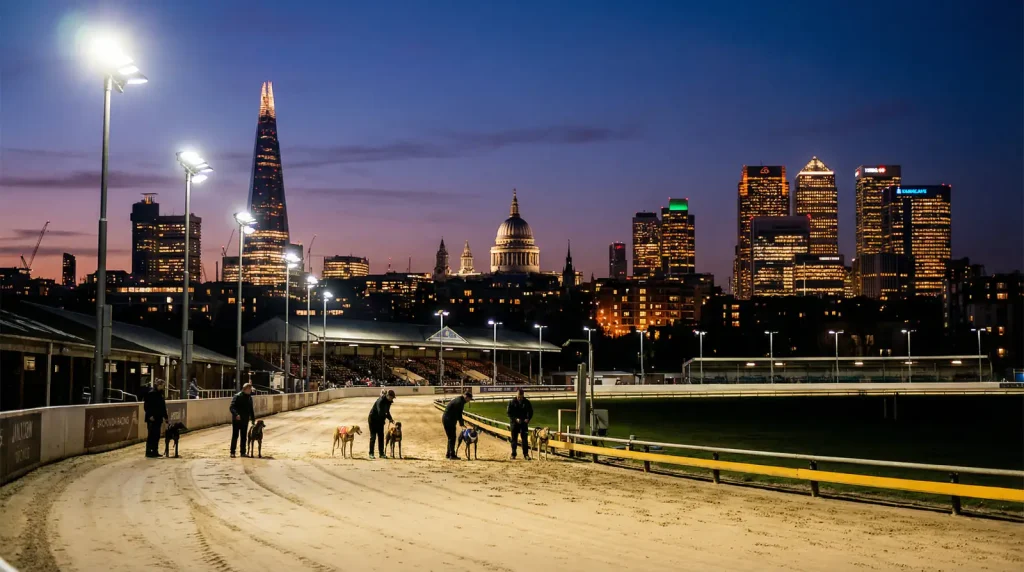
London was once the capital of greyhound racing. Not metaphorically — literally. At its peak in the mid-twentieth century, the city and its immediate suburbs hosted more than twenty licensed greyhound stadiums, from White City in the west to Catford in the south-east, from Harringay in the north to Wimbledon in the south-west. Millions of Londoners went to the dogs every year. The tracks were social hubs, entertainment venues, and betting institutions rolled into one, woven into the fabric of working-class and middle-class leisure in a way that is difficult to imagine from the vantage point of 2026. Find more London racing guides at crayfordgreyhound.
Today, Romford is the only GBGB-licensed greyhound track within the M25. Every other London venue has closed — some decades ago, others within living memory. The story of greyhound racing in London is a story of contraction: a sport that once dominated the city’s nightlife reduced to a single surviving outpost, with the closure of Crayford in January 2025 marking the latest and possibly most significant loss in a generation.
The Golden Age: White City, Wimbledon, Catford
The golden age of London greyhound racing ran from the late 1920s through to the 1960s. The sport arrived in Britain in 1926 (London Museum), and within a few years stadiums were springing up across London at a rate that reflected both the public’s appetite for a new form of entertainment and the commercial opportunities that came with it.
White City Stadium in Shepherd’s Bush was the jewel. Originally built for the 1908 Olympics (Olympics.com), it was converted for greyhound racing and became the home of the English Greyhound Derby — the sport’s most prestigious event. White City was glamorous in a way that few sporting venues could match: floodlit evenings, large crowds, and a sense of occasion that transcended the racing itself. The stadium hosted the Derby from 1927 until 1984 (Towcester Racecourse), establishing a tradition that made White City synonymous with the best in British greyhound racing.
Wimbledon Stadium, in south-west London, became the Derby’s home after White City closed and held it until its own closure in 2017. Wimbledon was a massive venue with a loyal following, and its loss was felt deeply by the London greyhound community. The stadium’s site has since been earmarked for development by AFC Wimbledon football club, a transition that symbolises the changing economics of urban land use.
Catford Stadium in south-east London operated from 1932 until 2003 (Twentieth Century Society). It hosted the Gold Collar for decades and was a cornerstone of the south London greyhound scene. Harringay, in north London, was home to the Golden Jacket before closing in 1987 (Engineering Timelines). Walthamstow, in east London, ran until 2008 and was famed for its atmosphere and its committed regular crowd. New Cross, Charlton, Clapton, Park Royal, Hendon — the list of closed London tracks is long, and each name represents a venue that once drew thousands of spectators on race nights.
During the golden age, London’s greyhound tracks were not just sporting venues but social institutions. They offered an affordable night out — admission was cheap, the racing was fast and frequent, and the betting was accessible. For working-class Londoners who could not afford horse racing at Ascot or Epsom, the dogs offered the same thrill of competition and wagering at a fraction of the cost. The tracks also served as community spaces: places to meet friends, eat, drink, and participate in a shared ritual that repeated several times a week.
Closures: Wimbledon 2017, Crayford 2025
The contraction of London greyhound racing accelerated from the 1970s onwards, driven by three converging forces: rising urban land values, declining attendances, and the shift of betting activity from trackside to shops and eventually to online platforms.
Land value was the decisive factor in most closures. A greyhound stadium occupies a significant footprint — several acres of prime urban land that, by the late twentieth century, was worth far more as residential or commercial development than as a racing venue. Track operators, many of whom also held the freehold on the land, faced an increasingly stark financial choice: continue running a stadium with declining revenue or sell the site for redevelopment at a substantial profit. In almost every case, the land won.
Wimbledon’s closure in 2017 (Sky Sports) was the most high-profile London loss in recent decades. The stadium had been the last London venue to host the Derby, and its end triggered a prolonged campaign by racing fans and local residents to save it. The campaign ultimately failed, and the site was acquired for the AFC Wimbledon football stadium project. The Derby moved to Towcester and subsequently to other venues as the sport’s geography shifted further from its London roots.
Crayford’s closure in January 2025 (Racing Post) removed the last track on the southern and eastern fringes of London. The decision by Entain to shut the stadium (Gambling Insider) was framed as a commercial necessity — declining attendance, insufficient entries, and a business model that no longer worked — but it also reflected the same forces that had closed every other London-area track. The land, the declining live audience, and the economics of operating a physical venue in an era of digital betting all pointed in one direction.
The cumulative effect is stark. A city that once supported more than twenty greyhound stadiums now has one. The sport that was once London’s most popular spectator activity after football has been reduced to a statistical footnote in the capital’s leisure landscape.
Romford: London’s Last Licensed Track
Romford Stadium, in the London Borough of Havering, is the sole surviving GBGB-licensed greyhound track in Greater London. It operates under the Coral Racing brand within the Entain group and runs a regular programme of evening and BAGS meetings throughout the week.
The track is a left-handed sand circuit of approximately 350 metres in circumference, with race distances ranging from 225 metres to 575 metres. It hosts several notable competitions, including rounds of Category One and Two events, and provides the only opportunity for London-based punters to attend live licensed greyhound racing without travelling outside the M25.
Romford’s survival is not guaranteed. It faces the same pressures that closed every other London track: the land beneath it has significant development value, the live audience is a fraction of what it once was, and the commercial logic of maintaining a physical stadium in the streaming age is precarious. Entain has not announced any plans to close Romford, but the company’s decision to shut Crayford — a comparable venue in a similar market — has inevitably raised questions about the long-term future of its remaining greyhound operations.
For punters, Romford’s status as London’s last track makes it an important venue regardless of its individual merits. It is where the capital’s remaining greyhound betting community concentrates its live activity, where transferred Crayford dogs have relocated, and where the in-person experience of London dog racing now exclusively resides. Its programme, its form data, and its racing character are worth understanding in depth — not because Romford is unique, but because for London it is the only option left.
Nearby Alternatives: Harlow, Sittingbourne
Outside the GBGB-licensed circuit, a handful of independent and flapping tracks operate in the areas surrounding London. These venues run greyhound racing under their own rules, without GBGB oversight, and the racing they offer is fundamentally different from the licensed product.
Harlow Stadium in Essex has historically offered independent greyhound racing on a smaller scale than the licensed venues. The fields, the grading, and the betting arrangements differ from GBGB tracks, and the form data is not integrated into the mainstream greyhound results databases. For punters accustomed to GBGB-standard racecards and calculated times, independent tracks require a different approach — more reliance on observation, less on published data.
Sittingbourne in Kent operates as a licensed GBGB track and provides a genuine alternative for punters in the south-east. It is smaller and less prominent than Romford or the now-closed Crayford, but it runs a regular programme and its results feed into the standard data systems. For Kent-based punters who previously attended Crayford, Sittingbourne is geographically closer than Romford and offers a familiar standard of licensed racing.
Further afield, Hove on the Sussex coast and the Midlands tracks — Monmore, Perry Barr, Nottingham — are accessible for London punters willing to travel. None replaces the convenience of a track within the capital, but all offer strong racing, deep form books, and the full range of betting opportunities. The trade-off between proximity and quality is one that London’s greyhound punters have been forced to make with increasing frequency as the local options have dwindled. Also explore our UK greyhound tracks.
The Capital That Lost Its Dogs
London built greyhound racing into a mass-participation sport and then dismantled the infrastructure that supported it, track by track, decade by decade. The process was not malicious — it was economic, driven by land values and audience decline rather than by any organised campaign against the sport. But the result is the same. A city of nine million people, with a deep cultural history in greyhound racing, now has a single licensed track. The dogs still run. They just run somewhere else.
