Crayford Greyhound Stadium Closure: What Happened
 Available in US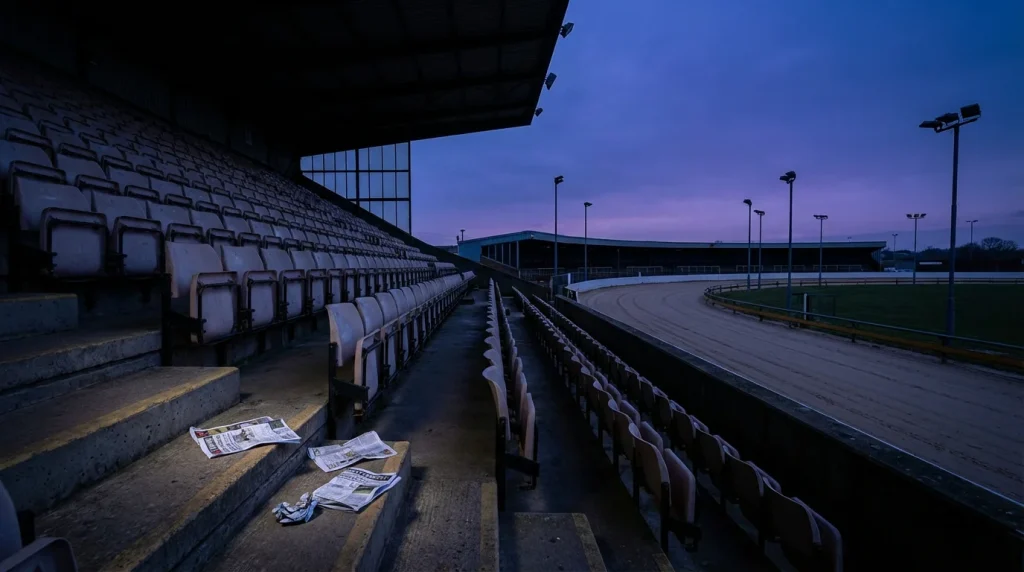
On 19 January 2025, Crayford Stadium hosted its final greyhound meeting. The traps opened for the last time, the dogs ran, the results were recorded, and then the floodlights went off for good. After thirty-eight years as a licensed GBGB venue, Crayford was closed by Entain — the gambling group that owns the Ladbrokes and Coral brands, and which had operated the stadium since its 1986 rebuild. The decision was commercial, the execution was swift, and the impact was felt immediately by the trainers, staff and punters who had made the track their base. Learn more about Crayford at crayfordgreyhound.
The closure was not a surprise to anyone paying attention. The warning signs had been visible for years: declining attendance, reduced race cards, difficulty attracting sufficient entries for full fields, and a growing imbalance between the stadium’s operating costs and its revenue. What was surprising was the speed. From the formal announcement to the final meeting, the process took roughly two months — barely enough time for the trainers who relied on Crayford as their primary venue to make alternative arrangements.
Timeline: November 2024 to January 2025
Entain confirmed in November 2024 that Crayford would cease operations in January 2025. The announcement cited long-standing commercial challenges that had made the stadium financially unsustainable. The company stated that it had explored options to keep the venue open but concluded that the business case no longer supported continued operation.
The November announcement triggered an immediate reaction from the Crayford racing community. Trainers based in the Kent area, who had relied on Crayford as their home track for years or decades, faced the prospect of relocating their operations to other venues — Romford, Hove, or further afield — at short notice. Support staff, from kennel hands to track maintenance workers, faced redundancy. The bookmaker pitches inside the stadium, the catering operation, and the administrative team all had weeks rather than months to wind down.
Between November and the final meeting in January, Crayford continued to race on a reduced schedule. The final weeks had an unusual atmosphere — part valediction, part business as usual. Regular punters attended in larger numbers than had been typical in the stadium’s later years, drawn by the finality of the occasion. The last meeting itself was staged without special ceremony: a standard evening card, standard graded races, standard results. There was no golden-ticket final or farewell open race. The track ended the way it had operated for most of its life — quietly, routinely, and with the dogs indifferent to the significance of the occasion.
Entain’s Reasoning: Numbers and Context
Entain’s stated reasons for closing Crayford centred on three interlocking problems: declining attendance, insufficient trainer interest, and the difficulty of staging competitive racing when dog numbers fell short of full fields.
Attendance at Crayford had been falling for years, mirroring a broader trend across UK greyhound racing. The stadium’s live gate — the number of paying spectators at each meeting — had dropped to levels that made the trackside operation economically unviable. Revenue from food, drink and on-track betting depends on physical attendance, and when the stands are largely empty, those income streams dry up. Crayford’s location, while accessible by road, was not well served by public transport, and the stadium lacked the modern leisure facilities that might have attracted a casual audience beyond committed racing fans.
Trainer recruitment was the more specific problem. GBGB regulations require a minimum number of entries to stage a race safely and fairly — six dogs per race, with reserves. As the pool of greyhounds available at Crayford shrank, the racing manager increasingly struggled to fill cards. The proportion of races run with five dogs instead of six rose, and some scheduled races had to be cancelled or merged. Entain’s statement noted that only 18% of races at Crayford in its final period were full six-dog fields — a figure that indicates a venue struggling to attract sufficient runners to sustain a credible racing programme.
Behind these numbers sat a structural issue. The economics of greyhound training are tight: trainers operate on thin margins, relying on prize money, owners’ training fees and breeding income. When a track’s prize money is modest and its race schedule uncertain, trainers redirect their dogs to venues with better returns and more reliable fixtures. This creates a downward spiral — fewer dogs lead to fewer races, which leads to lower prize money, which leads to even fewer dogs. Crayford was caught in this cycle, and Entain concluded that reversing it would require investment that the commercial outlook could not justify.
Impact on Trainers, Staff and Dogs
The immediate impact fell hardest on the trainers based in the Crayford area. A greyhound trainer’s operation is geographically anchored: the kennel is built near the home track, the dogs are trialled and raced there, the trainer’s relationships with the racing manager and other local handlers are built over years. Relocating to a new track means longer transport times, unfamiliar grading, and the loss of home-track expertise that took years to develop.
Several Crayford-based trainers transferred their operations to Romford, the nearest surviving licensed track. Others split their runners across multiple venues — some to Hove, some to Sittingbourne’s independent track, some further afield. A few trainers, particularly older handlers or those with smaller strings, chose to retire from the sport rather than rebuild at a new venue. The loss of their experience and their dogs further reduced the available pool of runners at the receiving tracks.
The greyhounds themselves needed rehoming or reassignment. Dogs that were still competitive were transferred to new kennels and continued racing at other tracks. Dogs at the end of their racing careers were retired and, where possible, placed through adoption programmes. The Retired Greyhound Trust and other welfare organisations reported increased demand for rehoming places in the months following the closure, as dogs from Crayford kennels entered the retirement pipeline in larger numbers than usual.
Stadium staff — track maintenance workers, kennel staff, administrative employees, catering and security personnel — were made redundant. Entain offered standard redundancy terms, but for workers who had spent years or decades at the venue, the closure represented the loss of a workplace that was also a community. Greyhound stadiums, by nature, employ relatively small teams who work closely together across long seasons, and the human cost of closing one is concentrated rather than dispersed.
Reactions from the Industry
The Greyhound Board of Great Britain acknowledged the closure and its impact on the sport’s infrastructure. GBGB expressed regret at the loss of a licensed venue but stopped short of challenging Entain’s decision, recognising that the commercial operation of individual tracks falls within the rights of their operators. The board’s focus shifted to supporting the transition — helping trainers find new homes for their dogs and ensuring that welfare standards were maintained during the wind-down.
Within the broader greyhound racing community, reactions were mixed. Some viewed the closure as inevitable — the predictable endpoint of years of declining investment and shrinking audiences. Others pointed to Entain’s broader corporate strategy, which has increasingly focused on digital gambling rather than physical venues, and questioned whether the company had done enough to support Crayford before concluding it was unviable. The argument that a billion-pound gambling group could have sustained one modestly sized greyhound track if it chose to was made repeatedly, though Entain’s position — that sustaining a loss-making venue indefinitely was not a reasonable commercial expectation — had its own logic.
Punters who had bet on Crayford races for years absorbed the loss and redirected their activity. Some moved to Romford. Some followed the BAGS schedule to whichever track was racing on a given afternoon. Some, particularly older punters for whom Crayford had been a social fixture as much as a betting venue, simply stopped going to the dogs. Also read our Crayford stadium history.
A Track Shut by Spreadsheets
Crayford’s closure was not caused by a single event. No scandal, no disaster, no dramatic falling-out between stakeholders. It was closed because the numbers stopped working — attendance down, entries down, revenue down, costs unchanged. The spreadsheet said stop, and the operator stopped. The floodlights went off not with a bang but with a line item in a quarterly review. For a stadium that had hosted nearly four decades of racing, thousands of meetings and hundreds of thousands of individual greyhound runs, the ending was as unremarkable as the data that sealed it.
