Early Pace in Greyhound Racing: Why It Matters
 Available in US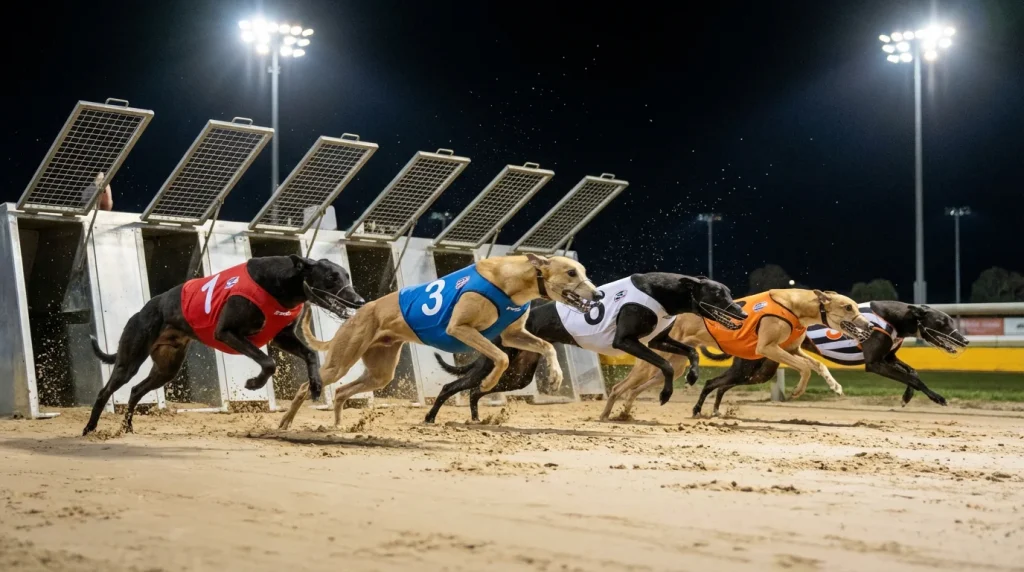
The first bend in a greyhound race is not just a turn — it is a filter. Dogs that reach it near the front have a fundamentally different race ahead of them than those arriving at the back. Clear running, a shorter path through the bend, and the psychological advantage of being chased rather than chasing. Everything that follows is shaped by what happens in those opening few seconds, and the metric that captures it — the split time — is the single most underused number on a greyhound racecard. Get more race analysis at crayfordgreyhound.
Early pace dominates greyhound racing to a degree that has no real parallel in horse racing or most other sports. A front-running horse can be tracked, challenged and outsprinted in the final furlong. A front-running greyhound, once clear at the first bend, rarely gets caught. The dynamics of a small, tight circuit with six runners and no jockeys to apply tactics mean that the dog in front at the first marker sets the terms for the entire contest. Understanding early pace is not a niche analytical exercise. It is the central question in form assessment.
What Split Times Measure
A split time records how long a greyhound takes to reach a specific point on the track, usually measured at the first timing line or the first bend. In UK greyhound racing, the standard sectional is taken at the first timing beam — typically positioned somewhere between 100 and 150 metres from the traps, depending on the track’s configuration. At Crayford, this measurement point arrived quickly given the 77-metre run to the first bend, making the split time there a near-direct measurement of trap speed and initial acceleration.
The split time is expressed in seconds to two decimal places. A typical split over the first section of a 415m race might range from around 3.80 seconds for a sharp front-runner to 4.20 seconds or slower for a dog with a moderate break. That 0.40-second gap sounds narrow, but in greyhound racing terms it equates to roughly three lengths — a distance that is difficult to recover across the remaining bends.
Split times serve a different purpose from overall finishing times. The finishing time tells you how fast the dog completed the full race distance. The split time tells you how the dog began. Two dogs can post identical finishing times but arrive at the first bend in entirely different positions: one leading comfortably, the other mid-pack. Their split times will differ, and those differences reveal contrasting racing profiles. The leader has early pace and probably controls the race from the front. The closer has stamina and finishing speed but lacks the initial acceleration to compete for early position.
For form analysis, the split time is the more predictive number. Finishing times are influenced by traffic, bend interference, the pace of the race as a whole, and how hard a dog needs to work to maintain or improve its position. The split time is largely free of these distortions: it measures the dog in isolation, before the field has bunched and before any significant interference has occurred. A dog with consistently fast split times is a dog that will be near the front at the first bend in its next race, regardless of the draw or the opposition. That consistency makes it a valuable betting factor.
Early Pace Leaders: Win Rate Statistics
The data on early pace and winning is unambiguous. Across UK greyhound tracks, the dog that leads at the first bend wins the race approximately 30-35% of the time. In a perfectly balanced six-dog race, the random expectation for any individual dog to win is 16.7%. The first-bend leader, therefore, wins at roughly twice the base rate. At tracks with short runs to the first turn — Crayford being the textbook example — the advantage was even more pronounced because the compressed run-up gave front-runners less time to be challenged and less opportunity for other dogs to recover from slow starts.
The second dog at the first bend wins roughly 20-22% of the time. The third sits around 15%. By the time you reach the dog that is last at the first bend, the win probability has dropped to single digits — somewhere between 5% and 8%, depending on the track and the distance. These numbers are not theoretical. They are compiled from thousands of races and they hold up consistently across different venues, different eras and different race types.
The implication is blunt: if you cannot identify which dog is most likely to lead at the first bend, you are guessing at the winner. The trap draw, the dog’s split-time history and its running style are the three inputs that answer this question. A fast-breaking railer from trap 1 at a tight track has an overwhelming structural advantage in the early-pace equation. A slow-breaking wide runner from trap 5 has almost none. The percentages reflect this without sentiment.
It is also worth noting what these statistics do not say. They do not mean that backing the probable first-bend leader is a guaranteed profit. Bookmakers are aware of early-pace dynamics, and the prices on front-runners tend to be shorter than the prices on closers. The favourite in a greyhound race is often the dog with the best early pace from the best draw, and favourites in UK greyhound racing win around 33-36% of the time — a figure that broadly tracks with the first-bend leader’s win rate. The edge from identifying early pace is real, but it is substantially priced into the market. The value lies in the occasions when the early-pace analysis disagrees with the market’s assessment — when a dog with sharp split times is drawn in a trap that the market undervalues, or when a confirmed front-runner is overlooked because its recent finishing positions were poor due to traffic rather than lack of ability.
Pace vs Staying Power: The Trade-Off
Not every dog with early pace sustains it. Greyhound racing, like any racing sport, involves a tension between initial speed and the ability to maintain that speed to the finish. Some dogs break brilliantly from the traps, lead at the first bend, and then visibly tire through the final straight — legs shortening, stride losing its snap, and challengers from behind sweeping past in the final twenty metres. These dogs have pace but not staying power, and their results show a pattern: first at the first bend, third or fourth at the line.
The inverse is also common. Dogs with moderate early pace that consistently finish strongly — making up ground through the closing stages — have staying power but lack the initial acceleration to take full advantage of it. They are the ones whose racecard shows bend positions of 4-3-2-1 or 5-4-3-2: progressively improving position as the race unfolds, but never quite getting there because the early deficit was too large. On a longer trip — 592m or 769m — these dogs come into their own, because the additional distance gives them more time to use their stamina. Over 415m, the distance simply runs out before they can close the gap.
The trade-off between pace and stamina is distance-dependent. Over a 238m sprint, staying power is almost irrelevant. The race is over before any dog has time to tire. Over 946m, early pace still matters — the first bend still sets the field — but the advantage is diluted because there are so many more bends and so much more race left for the stayers to use their strength. The standard 415m trip is where the tension is most finely balanced. A front-runner with just enough stamina to hold on will beat a closer with fractionally more finishing speed, and the margins between the two are often less than a length.
For bettors, the pace-stamina balance is most useful when a dog is changing distance. A 238m sprint specialist moving up to 415m may still have the early pace to lead but might not sustain it against dogs conditioned for the longer trip. Conversely, a 592m runner dropping to 415m might find the shorter distance too sharp for its finishing style. Checking the split times against the finishing positions at the new distance — rather than relying on the dog’s record at its previous trip — is how to separate the form that transfers from the form that doesn’t.
Using Sectional Data in Selection
Practical application of split-time data follows a straightforward sequence. First, identify each dog’s average split time across its last three to five runs. One fast split in isolation can be an anomaly — a particularly clean break, a favourable draw, a weak field that didn’t contest the early pace. Three or more fast splits in succession indicate a genuine front-runner. Three or more slow splits indicate a dog that reliably starts slowly, regardless of draw or competition.
Second, compare the split times against the trap draw for the upcoming race. A dog with the fastest average split drawn in trap 1 or trap 2 at a tight track has a strong probability of leading into the first bend. The same dog drawn in trap 6 might be fast enough to lead but has to cover extra ground to get there, reducing the certainty. A dog with the third-fastest split drawn in trap 4 might actually reach the bend ahead of faster dogs who are drawn in positions that create traffic.
Third, assess the likely pace map for the entire race. If two dogs in the same race have very similar fast split times and are drawn next to each other, they will compete for the lead at the first bend — and that competition can compromise both of them. A dog with a slightly slower split drawn on the opposite side of the track might benefit from the two pace-setters interfering with each other, getting a clean run to the bend while the others tangle.
This layered approach — average splits, draw compatibility, pace-map construction — takes the raw sectional data and turns it into a prediction about the shape of the race. It does not guarantee the winner. It identifies the most likely scenario for the opening phase of the contest, which is where the majority of greyhound races are decided. The split time is one number. The analysis it enables is considerably richer than the number alone. Also read our track conditions guide.
Speed at the First Bend Decides More Than You Think
The temptation in any form sport is to focus on the finish — who won, by how much, in what time. Greyhound racing rewards the opposite approach. The decisive moment is usually the first bend, not the last straight. The data confirms this, the race dynamics explain it, and the split time quantifies it. Start your analysis at the start. Everything else follows.
