Greyhound Running Styles: Rails, Middle, Wide
 Available in US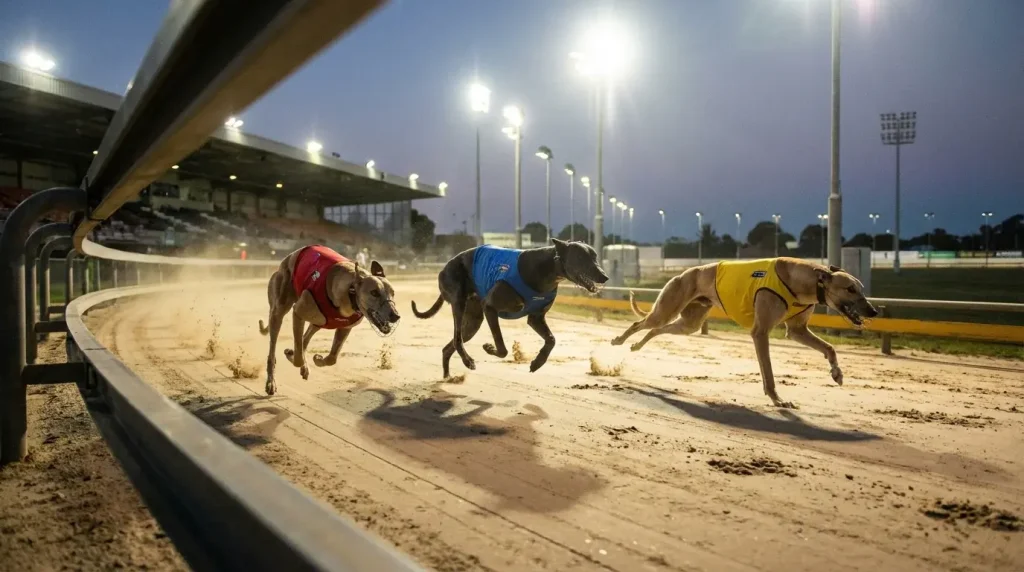
Every greyhound has a preferred running line, and it is one of the first things a racing manager considers when building a racecard. Some dogs hug the inside rail as if magnetically attached to it. Others drift wide through every bend, covering extra distance but staying clear of traffic. A third group runs down the middle, splitting the difference. These tendencies are not random — they are deeply ingrained, established in a dog’s earliest races, and they rarely change over the course of a career. A railer at two years old is almost always a railer at four. Get more race analysis at crayfordgreyhound.
Running style matters because it determines where a greyhound will be in a pack of six dogs all trying to negotiate the same bends at roughly the same speed. On a tight circuit, the inside rail is the shortest route. The outside is the longest. The difference might sound trivial — a few metres per bend — but greyhound races are decided by fractions of a length, and those fractions add up across four, six or eight bends depending on the distance. A dog’s running style interacts with its trap draw, its early pace, the styles of the dogs around it, and the geometry of the track itself. None of these variables operate in isolation, but running style is the one that stays constant from race to race.
Rails Runners Explained
A rails runner — a railer — is a greyhound that naturally seeks the inside line through the bends. Given a clear run, it will tuck against the rail immediately after the break and maintain that position throughout the race, saving ground on every turn. The racecard abbreviation RnUp (ran up) frequently appears in a railer’s form, and its bend positions will show it consistently near the front on the inside.
The advantage of railing is geometric. On a 334-metre circuit like Crayford’s, the inside rail is the baseline distance. Any path wider than the rail adds metres to the total distance covered. A dog running one metre wide of the rail on every bend might cover an additional four to six metres over a standard 415m race — enough to account for a full length or more. At the margins where greyhound races are decided, that saving is substantial.
The disadvantage is vulnerability to traffic. A railer trapped on the inside (trap 1 or trap 2) has a direct path to its preferred line. A railer drawn in trap 4 or trap 5 has to work across the field to reach the rail, and in doing so, it risks interference from other dogs. Worse, a railer that gets trapped behind a slower dog on the rail has nowhere to go. It cannot easily switch to a wider line — its instinct keeps it inside — so it either waits for a gap that may never open or gets shut out entirely. This is why trap draw is so critical for railers: the right draw unlocks their advantage, and the wrong draw can negate it completely.
Racing managers at UK tracks assign traps with running style in mind. A known railer will typically be drawn in traps 1, 2 or 3, where its path to the rail is shortest. When a railer is drawn wide — trap 5 or trap 6 — it is often because there was no alternative in the grading, and the dog’s chances are immediately compromised. Experienced punters flag these mismatches as a negative and adjust their assessments accordingly.
Middle Runners: The Flexible Option
A middle runner does exactly what the name suggests: it runs a central path through the bends, neither hugging the rail nor swinging wide. This sounds like a compromise, and in geometric terms it is — the middle runner covers more ground than the railer but less than the wide runner. What the middle runner gains, however, is flexibility.
A dog running down the middle has options that a committed railer does not. If space opens on the inside, a middle runner can angle towards the rail to save ground. If the inside is blocked, it can drift slightly wider to find a clear path. This adaptability makes middle runners less dependent on a specific trap draw. They can perform reasonably well from any starting position because they are not committed to a single racing line that requires a particular route from the traps.
The trade-off is that middle runners are more affected by the composition of the field around them. A railer’s path is determined by the rail — it is fixed, predictable, and independent of the other dogs’ positions provided the rail is clear. A middle runner’s path is shaped by the dogs to its left and right. In a race where the field spreads evenly, the middle runner has room. In a race where multiple dogs converge towards the centre of the track through a bend, the middle runner gets squeezed.
On the racecard, middle runners are less likely to show the extreme abbreviations — no consistent RnUp like the railers, no VW (very wide) like the wide runners. Their form tends to be steadier but less spectacular. They win at a reasonable rate across a range of trap draws, without the sharp peaks and troughs that characterise railers drawn well or badly. For bettors, middle runners offer a degree of predictability that makes them useful in forecast and tricast calculations: you can be reasonably confident about their approximate finishing position without needing a perfect draw.
Wide Runners and Outside Draw
A wide runner takes the broadest line through the bends, running two or more metres away from the rail. The VW abbreviation is a frequent companion in the form lines of these dogs, and their trap assignments typically reflect the preference: traps 5 and 6 are the natural home for wide runners, giving them open air on the outside without needing to cross the field.
The obvious disadvantage is distance. A wide runner covers more ground than a railer or a middle runner on every single bend. Over four bends in a 415m race, that extra distance can amount to a length or more — a deficit that must be overcome purely through speed. Wide runners that win regularly are, by definition, fast enough to absorb the extra ground and still reach the line first. When they lose, the margin is often slight, and the racecard will show them finishing within a length or two of the winner despite the wider path.
The advantage — and it is a genuine one — is clear running. A wide runner rarely encounters the traffic problems that plague railers and middle runners through the bends. There is no dog on its outside, and the dogs on its inside are running a tighter line that takes them away from the wide runner’s path. Barring an extreme case where the entire field swings wide, the outside runner has an unimpeded view of the bend and can maintain full stride without checking or adjusting. This clean running can produce faster split times through individual bends than a railer achieves, even though the railer covers less distance, because the railer might have to adjust its stride to avoid traffic while the wide runner powers through unimpeded.
Wide runners are often misunderstood by casual punters. The visual impression of a dog running wide — swinging out on every bend, apparently covering unnecessary ground — looks wasteful. But if the dog’s speed compensates for the extra distance, the wide run is not a flaw; it is a strategy. The best wide runners at Crayford and other tight UK tracks were dogs that traded ground for momentum, maintaining a higher average speed through the bends because they never had to decelerate for traffic.
How Running Style Interacts with Trap Draw
The relationship between running style and trap draw is the single most actionable piece of analysis on any greyhound racecard. A railer in trap 1 is in its ideal position. A railer in trap 6 faces a near-impossible task. A wide runner in trap 6 has clear air from the start. A wide runner in trap 1 must either cross the entire field to reach the outside — losing ground and risking interference — or abandon its natural style and attempt to rail, which it almost certainly does badly.
The match or mismatch between style and draw creates predictable advantages and disadvantages that show up in the finishing data. At Crayford, dogs drawn in traps aligned with their running style won at significantly higher rates than those in mismatched positions. Trap 1 railers outperformed trap 1 wide runners by a margin that made the form figures from previous races almost secondary. The draw-style combination was the primary variable.
For bettors, this interaction is the foundation of a practical selection method. Before assessing form, speed figures or grade, check two things: the dog’s running style and its trap draw. If they align, the dog has a structural advantage. If they conflict, the dog is starting with a handicap that no amount of raw speed can reliably overcome. This filter eliminates dogs from contention before you even look at the stopwatch — and any filter that narrows a six-dog field to four or three credible contenders is doing useful work.
The grading system at GBGB-licensed tracks is supposed to match running styles with appropriate traps. Racing managers generally succeed in this, which is why the most extreme mismatches are rare on graded cards. But they do occur, particularly in open races where the draw is less controlled, or in races where the local pool of dogs doesn’t allow for a neat style-to-trap assignment. When mismatches appear, they are opportunities — both to oppose the mismatched dog and to back the one that drew perfectly. Also read our early pace guide.
Style Is Set, but the Race Is Not
Running style is the most stable variable in greyhound racing. Dogs do not learn new lines. A railer does not wake up one morning and decide to run wide, any more than a left-handed tennis player switches to right. The consistency is the point — it makes running style one of the few genuinely predictable elements in a sport where the unexpected is routine. Use that predictability. Match the style to the draw, check the pace map, and let the geometry do the work that guesswork cannot.
